

Many inboxes, one set of actions
WhatsApp, Instagram, Messenger, web chat and email have different APIs, permissions and rate limits, yet the business wants one agent and one record of the conversation.
AI agents · multi-tenant SaaS architecture
UAE AI Studio is not another custom chatbot per customer. The idea is to productise the repeatable daily jobs of a small business, answering enquiries on WhatsApp and website chat, qualifying leads, booking appointments, handling email and moving information into spreadsheets, so a company can subscribe to a useful agent instead of commissioning its own software project. The public site is a launch page; the platform is being built.
AI automation agency DubaiProject overview
Small businesses run on messaging and email. Enquiries arrive on WhatsApp, Instagram, Messenger and web chat, and most of them need the same few actions: answer a question, qualify the lead, offer a time, send a quote, record the result. UAE AI Studio is being designed as a subscription platform where a business turns on agents for those jobs, connects its channels and sees what the agent actually did.
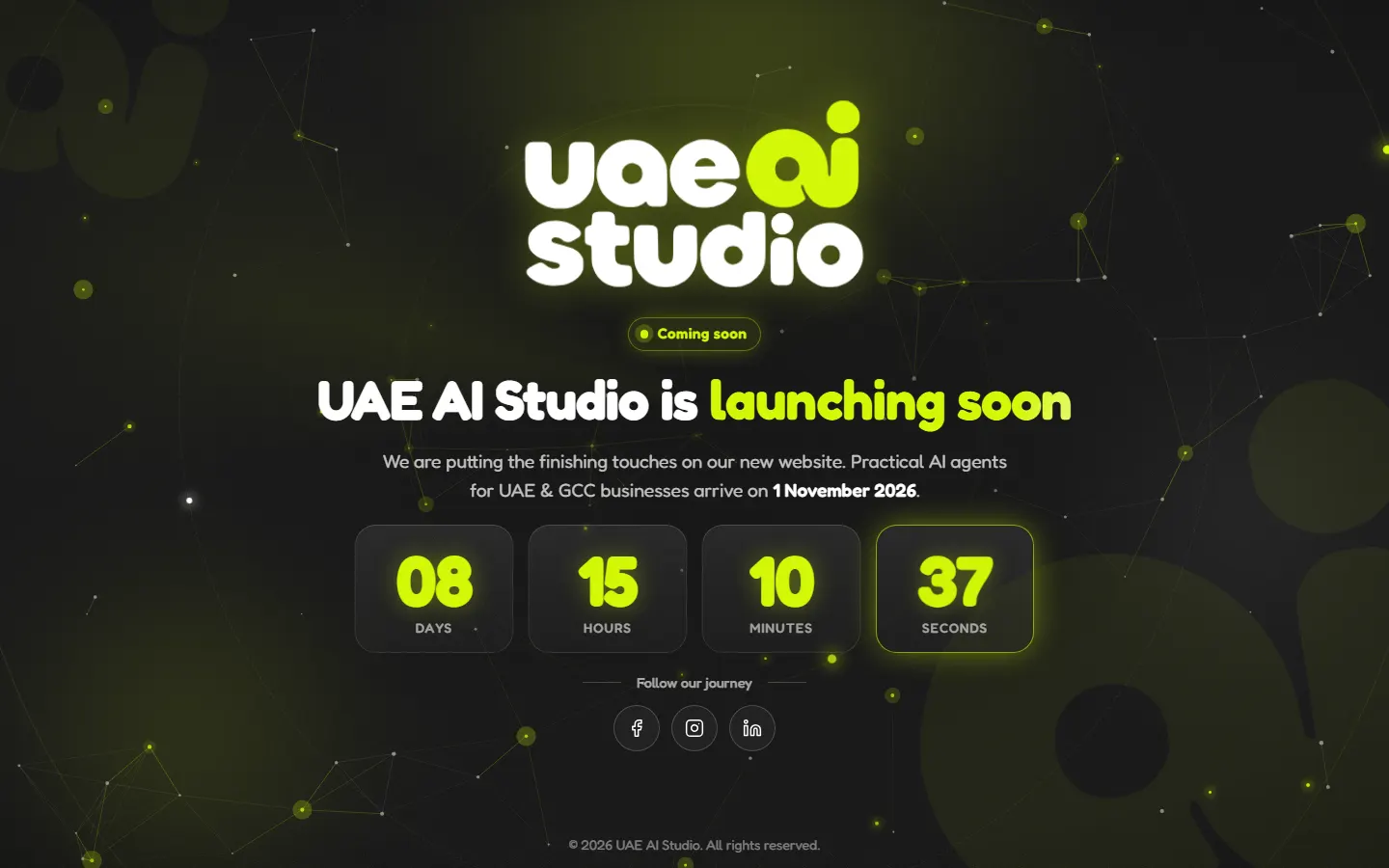
The public site, as of the review date, is a launching-soon page announcing practical AI agents for UAE and GCC businesses from 1 November 2026. That is the entire verifiable product today, and this case study is written accordingly: it documents the design and architecture decisions of a product in development, the constraints that shaped them, and the honest cost of building the full platform versus the landing page that exists.
The reason to publish a pre-launch study is that the hard decisions are being made now: how tenants are isolated, how an agent is prevented from replying twice or sending a draft, how usage is metered so a low entry price survives real API costs. Those are architecture questions, and they are what a prospective client should want to see before commissioning a platform of their own.

The original challenge
A fluent reply is the easy part. A usable subscription product needs permissions, billing boundaries, secure third-party connections, automation controls and a record of what the agent completed.
WhatsApp, Instagram, Messenger, web chat and email have different APIs, permissions and rate limits, yet the business wants one agent and one record of the conversation.
Webhooks retry, messages arrive out of order and drafts must stay drafts until a human or a rule says send. Idempotency and state are product features here.
Multi-tenant isolation covers conversations, contacts, documents, bills and channel credentials; a single leaky query is a breach.
Model tokens, messages, document processing and provider charges are variable; the subscription needs limits the customer understands and margins the operator can see.
Engineering decisions & solutions
These are design decisions for a platform in development. Each outcome states what exists today, which in most cases is a design, not a production system.
Decide what the product is before building channels.
Selling a bespoke chatbot to every customer is consulting, not a product; a subscription needs a catalogue of modules that work the same for every tenant.
Define a module catalogue around repeatable jobs: WhatsApp enquiry replies, Instagram and Messenger responses, email assistance, lead capture, booking support, document extraction and spreadsheet synchronisation.
A module catalogue and the data each module produces (leads, follow-ups, appointments, quotes, tasks) are specified; the first narrow end-to-end automation is being built before more channels are added.
A catalogue constrains what the agent can be asked to do; that constraint is what makes support, billing and quality control possible.
Design complete; implementation in progress. No module is publicly available yet.
Keep every business's conversations, contacts, documents, credentials and bills strictly separate.
A multi-tenant platform that leaks one record across tenants has failed completely, whatever else it does.
Scope every query by tenant at the data-access layer, store channel credentials per tenant with encryption, and write isolation tests before writing features.
Tenant scoping is designed into the data model and the access layer; credentials are planned as encrypted per-tenant secrets with least-privilege access to provider APIs.
Universal tenant scoping adds overhead to every query and makes cross-tenant reporting a deliberate, separately authorised path.
Design decision with planned tests; tenant and security test results are to be published after QA.
Guarantee that an agent working with customer messages respects permissions, replies once and records what it did.
Duplicate replies, sent drafts and silent actions destroy trust with the customer's customers; audit records are how disputes are resolved.
Model every inbound event with a unique key, every outbound action as a state machine (drafted, approved, sent, failed) and every decision as an audit entry.
Event deduplication, action states and audit logging are specified; channel on/off switches, explicit consent and operator review or escalation for sensitive decisions are part of the control design.
Human review points slow down fully automatic replies; the platform is designed to earn automation per tenant rather than assume it.
Design in place; retry handling and provider permission flows are to be validated in implementation.
Show the business what the agent produced, not how many messages it processed.
Businesses buy outcomes: leads, follow-ups, appointments, quotes, tasks. A message counter is activity, not value.
Turn completed work into business objects in one workspace and report on those.
The planned dashboard organises work as leads, follow-ups, appointments, quotes and tasks linked back to the originating conversation.
Mapping free-form conversations to structured objects needs clear rules and occasional human correction.
Planned dashboard; screenshots will be added only once the screens exist and are approved.
Keep a low entry price sustainable.
Tokens, messages, document processing and provider fees are variable; a flat price without limits is a loss waiting to happen.
Give each subscription explicit limits for tokens, messages and document processing; meter provider charges per tenant; make variable costs and margin visible to administrators.
Usage metering and plan limits are specified alongside the module catalogue; invoice generation and cost monitoring are on the build list.
Visible limits are less glamorous than unlimited claims; they are the only honest way to price this product.
Design decision; billing is not live.
Main features
These are the planned modules and controls of the platform. None is publicly available on the review date; the launch page is the only live surface.
Technical architecture
The planned platform is a Laravel multi-tenant application: tenant-scoped data access, encrypted per-tenant channel credentials, a queue-driven event pipeline for inbound messages, an action state machine for outbound work, and a metering layer that records usage per tenant for billing.
What is live is a static launching-soon page. The architecture below is the design that is being implemented, and it is labelled as such.
What we deliberately leave out: model providers, prompt content, provider credentials and infrastructure are not described, and nothing planned is presented as validated in production.
| Layer | What is in place |
|---|---|
| Live today | Static launch page with a 1 November 2026 countdown |
| Backend (planned) | Laravel multi-tenant application with tenant-scoped data access and role-based permissions |
| Events (planned) | Queue-driven inbound pipeline with unique event keys for deduplication and ordered processing |
| Actions (planned) | Outbound state machine: drafted, approved, sent, failed; audit entry per decision |
| Channels (planned) | WhatsApp, Instagram, Messenger, website chat, email, each behind consent, permissions and rate limits |
| AI orchestration (planned) | Module-specific prompts and tools with per-tenant limits; human review and escalation points |
| Billing (planned) | Plan limits for tokens, messages and documents; metered provider charges; invoices and cost monitoring |
| Security (planned) | Encrypted per-tenant secrets, least-privilege provider access, isolation tests before features |
User experience & responsive design
Genuine screenshots of the public site captured on 23 October 2026. Hover and click any image to open it in the viewer; click again for actual size.
The live site states what it is: a product launching on 1 November 2026, with a countdown and a follow-our-journey prompt. No feature is claimed on the page that does not exist.
The dashboard is designed around leads, follow-ups, appointments, quotes and tasks, not message totals.
Channel switches, consent prompts and review queues use plain language, not automation jargon.
Plan usage is visible before it runs out, so a surprise bill or a silent cut-off never happens.
Review and escalation screens are designed for the phone, where business owners actually approve replies.
The launch page uses semantic headings and readable contrast; the planned dashboard inherits the same rules.
Technical challenges & resolutions
Each row records how it was verified and what remains open. Items marked as recommendations have not been implemented yet.
| Challenge | Root cause / constraint | Solution | Verification | Result or remaining limitation |
|---|---|---|---|---|
| Replying twice or sending drafts | Webhook retries and out-of-order delivery | Unique event keys, action state machine, approval before send | Planned: retry and ordering tests per channel | Design; not yet validated in implementation |
| Cross-tenant data exposure | Shared tables across businesses | Tenant scoping at the access layer, encrypted per-tenant secrets, isolation tests first | Planned: automated isolation tests and security review | Design; results to be published after QA |
| Unbounded AI and provider costs | Flat pricing with variable usage | Plan limits, per-tenant metering, admin cost monitoring | Planned: billing reconciliation tests | Design; billing not live |
| Provider permissions and approvals | Channel APIs require verified business access and scoped permissions | Validate Meta and mailbox permissions on one narrow automation first | Planned: end-to-end test of the first module | In progress |
| Launch messaging drifted | An earlier launch date passed before the page was updated | Publish an accurate status page and keep the countdown honest | Page shows 1 November 2026 on the review date | Updated; a product-status page is a recommendation |
Estimated market development cost
Two very different numbers apply here. The headline range is what the full planned platform would cost to commission: multi-tenant users and security, messaging integrations with approvals, AI orchestration, usage billing and production operations. The launch page that exists today is a much smaller project. Editorial estimates for comparable work, not quotes.
Full planned platform, 2026 market range
AED 175,000 – 600,000
Roughly 1,100–2,400 hours for the full planned platform at a blended agency rate; scope-dependent.
The current launching-soon page alone would be roughly AED 2,500–7,500. The headline range is the estimated value of the complete product once built, not the development value of what is live today.
Illustrative market development estimate for a comparable scope. This is not the actual project invoice, historical development cost or amount charged to a client.
| Comparable delivery component | Estimated range (AED) |
|---|---|
| Platform discovery and UX design | 20,000 – 60,000 |
| Multi-tenant users, security and admin | 40,000 – 130,000 |
| Messaging integrations and approvals | 40,000 – 160,000 |
| AI orchestration and workflow execution | 35,000 – 125,000 |
| Usage billing, QA and production operations | 40,000 – 125,000 |
Component ranges are illustrative phase allocations, not measured hours or invoices. Third-party subscriptions, paid APIs, content production, hosting and marketing are excluded. Market context: Clutch web development pricing guide (Sept 2026), Dubai website cost comparison (Sept 2026) — editorial estimates by WebStackRank, not independently obtained quotes.
Results & outcomes
A pre-launch product has design outcomes, not delivery outcomes. The list below is deliberately modest.
A launching-soon page with a 1 November 2026 countdown; no feature claimed that is not live.
Repeatable agent jobs and the business objects each produces, scoped for a subscription product.
Tenant-scoped access, encrypted per-tenant credentials, channel switches, consent, review and escalation points.
Event deduplication, an outbound state machine and audit entries so an agent replies once and leaves a record.
Plan limits and per-tenant metering so a low entry price can survive real provider costs.
The first end-to-end module is being built and validated before more channels are added.
What this page does not claim: any production capability, customer, integration, performance figure or revenue. Screenshots of the dashboard will be added only once those screens exist and are approved for publication.
Lessons learned
Project status
Pre-launch · in development
As of 23 October 2026, uaeaistudio.com shows a launching-soon page with a countdown to 1 November 2026. A customer dashboard, channel integrations, subscription checkout and production agent actions were not available for public verification. This case study describes the planned product and its architecture as design work in progress, not as delivered software.
Status and figures reviewed on 23 October 2026 against the public site. UAE AI Studio is an in-house product in development, owned and operated by the WebStackRank founder.
Related projects
Whether you're planning a booking platform, SaaS product, business website or custom application, WebStackRank can help you turn the idea into a practical, maintainable digital product.
How would you like to reach us?
Thanks for chatting!
It was lovely to connect. Come back anytime — our starter packages and their 3 months free maintenance are on the pricing page whenever you're ready. See you again!
See the pricing page