A salon or spa website is a booking engine wrapped in a brand — not a digital brochure. The strongest designs load fast on mobile, put "Book Now" one tap away, and pair authentic photography with local SEO. Get those three right and Instagram traffic turns into appointments.
Ready to stop leaking bookings? Get an instant estimate for your salon website build and see what a conversion-first rebuild costs.
What does salon and spa web design actually involve?
"Beauty industry" covers a wider mix than most owners realize: hair and nail salons, day spas, med spas, barber shops, lash studios, brow bars, esthetician practices, and hybrid wellness brands. Each has slightly different needs, but they share one customer journey — a potential client discovers you on Instagram, Google Maps, or a friend's recommendation, taps through on a phone, and decides in seconds whether to book or bounce.
Beauty web design exists to win that fifteen-second window. A salon site is not a corporate site with a contact form buried at the bottom. It is a reservation system surrounded by brand: visuals that feel like walking into your space, booking that takes one or two taps, and pages that load instantly on mobile data. Miss any of the three and the site is decorative — pretty, but commercially dead.
That is why serious builds start with the customer journey, not a template gallery. Our salon and spa industry web builds follow exactly this pattern — booking-first architecture, brand-led visuals, and mobile speed as a baseline, not a stretch goal. Core web development services cover the same ground for appointment-based businesses generally, since salons share conversion mechanics with clinics and dental practices — a point made well in our medical practice website guide.
Why do most salon and spa websites fail to generate bookings?
Audit salon sites in any city and the same three failures appear on repeat. None is mysterious; each is expensive.
The booking button is buried. It hides in a nav menu, behind a hamburger icon, or labeled "Reservations" instead of "Book Now." Mobile visitors have to hunt for it. Think with Google's local search research finds the majority of beauty and wellness searches now happen on mobile devices — so a hidden booking button is arguably the single costliest design choice a salon owner can make.
The photography is generic. Stock images of strangers, oversaturated banners, or template default imagery with the wrong color palette. A salon is a visual business. If the photos don't match the experience inside your door, trust collapses before anyone books. Around six in ten global website visits now come from a phone (Statista), which means those generic hero images are being judged on a five-inch screen in seconds.
The site is slow. Drag-and-drop templates routinely ship 4 to 6 MB of homepage assets — autoplay video, carousel heroes, uncompressed images. Google's web.dev documentation sets the bar plainly: pages whose largest element renders after 2.5 seconds lose a meaningful share of mobile visitors before the booking page ever appears. Our Core Web Vitals and indexing guide breaks down exactly how that threshold works and how to hit it.
Sites that ignore these three problems exist online but produce no revenue. The deeper error is treating the website as a finished product instead of a working instrument — one that needs measurement and tuning every quarter. That measurement-first mindset is also why pairing a build with local SEO for service businesses outperforms a design-only refresh: fixes get tested against rankings and bookings, not opinions.
How should the booking system work on a salon website?
For salons, spas, and med spas, booking is the heart of the site — every other page exists to push traffic toward it. Four integration patterns dominate in 2026:
- Embedded third-party widget. Tools like Fresha, Vagaro, Boulevard, Mindbody, and Phorest drop a calendar into your page. Fast to deploy, moderate on customization.
- API-integrated booking. Your design, their engine underneath — clients never feel they left your site.
- Native booking build. Custom scheduling written into the site itself. Maximum control, maximum cost.
- Hybrid assisted booking. Online booking plus a tap-to-call fallback for older clients and complex requests.
Whichever you choose, the UX rules don't change: booking must be reachable in one tap from any page, the widget must render in-place (modals break on iOS Safari), and the flow must work flawlessly on a phone — where roughly 80% of beauty traffic starts. This is where lead-generation UX and CRO principles matter most: every extra field and every extra tap in the booking flow measurably costs appointments.
Deposits deserve special attention. Beauty platforms consistently report that free bookings produce no-show rates approaching one in four, while deposit-backed bookings cut no-shows to low single digits. A $20–$50 deposit on a service booking filters serious clients without scaring real ones away — and our salon & spa industry builds wire deposit logic into the flow rather than bolting it on afterward. Appointment businesses face the same challenge everywhere; see how dental website booking flows solve it for comparison.
What makes a salon or med spa site look premium?
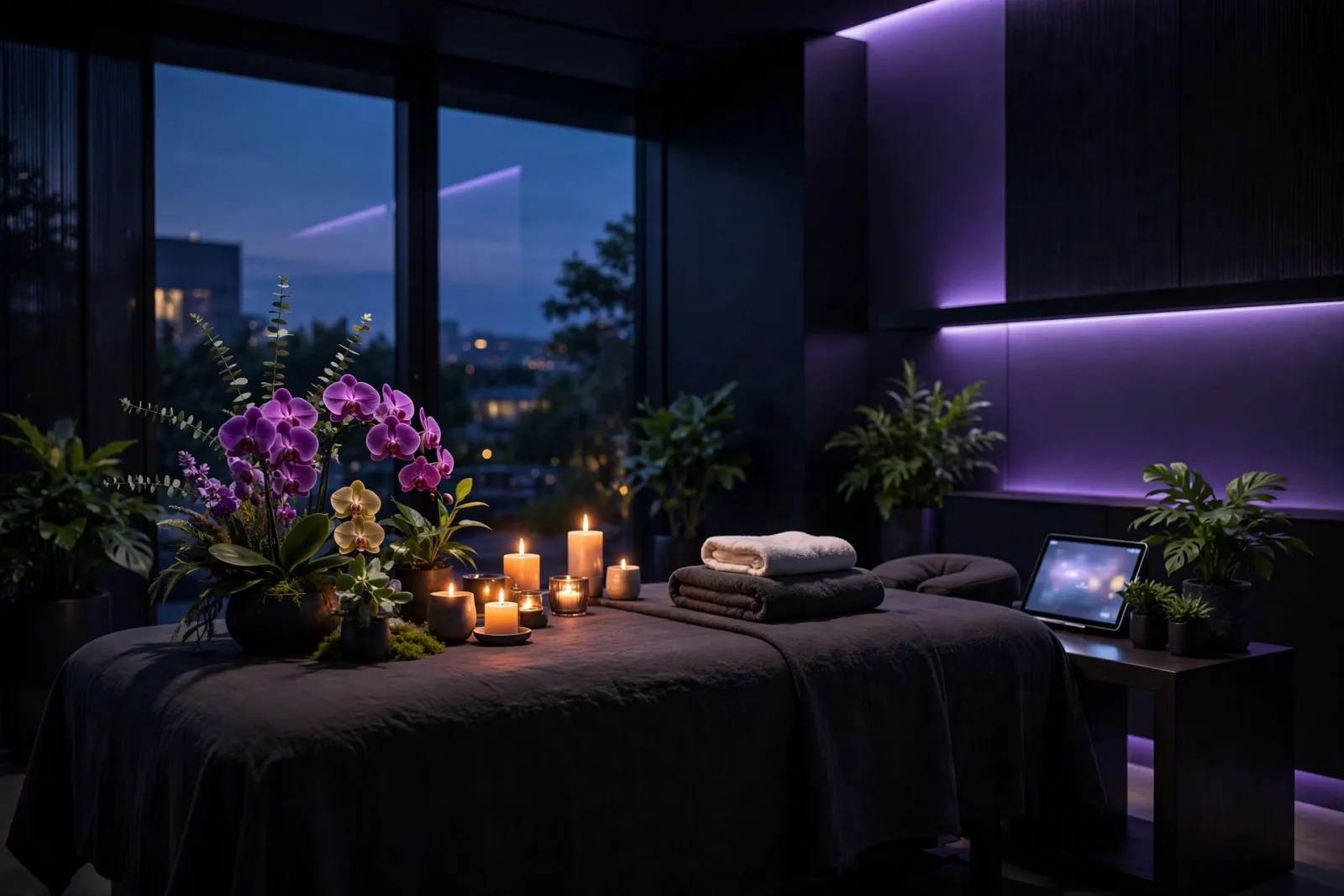
Premium in this category has a formula: real photography, restraint, and mobile reading rhythm.
Real photography beats stock every time. A half-day shoot with a local photographer yields 30–40 usable images: a hero shot, service close-ups, team portraits, and interior establishing shots. Visitors can tell stock from real in a glance — and in a trust business, that glance decides the booking.
White space is a feature. Sites that fill every pixel read as cheap. The best spa design treats empty space as part of the luxury signal.
Mobile reading rhythm. Paragraphs of two to three lines, generous line height, 16–18px minimum type. Most of your readers are scrolling one-handed.
Brand before website. If the identity isn't settled — logo, palette, type, voice — fix that first. A beautiful site on a weak brand is wallpaper over a crack. As Steve Jobs famously put it, "Design is not just what it looks like and feels like. Design is how it works." That sequencing is exactly why we offer branding work upstream of design, and it is the same advice in our photography portfolio design guide, which covers how to present visual work so it converts instead of just decorating.
How much does a salon website cost in 2026?
Four paths, compared on what actually matters:
| Approach | Upfront cost | Build time | Brand fit | SEO ceiling | Best for |
|---|---|---|---|---|---|
| DIY builder (Wix, Squarespace) | $0–$500 | 1–2 weeks | Generic | Low–moderate | Solo barber, brand-new operator |
| Themed template | $500–$2,500 | 2–4 weeks | Recognizable | Moderate | Single-location salon testing the market |
| Custom build + booking integration | $4,000–$15,000 | 4–8 weeks | Distinct | High | Established salons, med spas, multi-location brands |
| Fully bespoke front-end with API booking | $15,000+ | 8–16 weeks | Fully unique | Very high | High-end med spas, beauty chains |
The right choice depends less on budget than on how central the site is to revenue. If most new clients arrive through the website, a custom build pays for itself in months. If walk-ins and word of mouth dominate, a template may serve for now. For current market pricing context, see how much a website costs in 2026 and get a number specific to your project with our instant quote calculator. A Nielsen Norman Group finding worth remembering here: mobile users show low tolerance for friction — every tap between "I want this" and "booked" is a tax.
Which mistakes should salon owners avoid?
The same patterns repeat across thousands of beauty sites, and most are fixable in a single sprint:
- Hiding all prices. Med spas often gate pricing behind consultations. That works for surgery; it kills conversions for facials, trims, and manicures. Publish at least a range.
- No cancellation or deposit policy. Clients burned by no-show fees check this before booking. Bury it and they bounce.
- Stale team pages. Three of four pictured stylists no longer work there. Team pages belong on a monthly checklist.
- One "Services" page for everything. Twelve sub-services in a bullet list ranks worse and reads worse than twelve dedicated pages. This is the single biggest SEO miss in the category — and the reason our SEO audit checklist starts with site architecture.
- Generic location pages. Mention the neighborhood, cross streets, parking, and transit. That local detail is also where local search traction comes from.
- Autoplay video on mobile. Impressive on a designer's laptop; punishing on a 4G connection.
- Contact form with no phone number. Older demographics still prefer calling. Hiding the number is a conversion tax.
- Missing basics. No favicon, broken Instagram share images, no schema markup — each fixable in an afternoon.
Auditing against this list before any redesign is one of the cheapest exercises in beauty marketing. Owners routinely discover that two or three quick fixes outperform a full rebuild for the first 90 days.
What does a real salon website rebuild look like?
Consider an illustrative scenario drawn from common patterns in this category. A two-location med spa averages 80 online bookings a month. Its site was built on a generic template in 2021. Mobile load time: 4.2 seconds. The booking widget opens in a modal that breaks on iOS Safari. No service-specific landing pages exist — every treatment sits on one "Services" page. The site ranks for its brand name and nothing else.
The rebuild follows three priorities: speed, structure, search.
Speed first. Move to a static front-end, serve images from a CDN, cut homepage weight from 5.1 MB to about 800 KB, and bring Largest Contentful Paint under 1.8 seconds on a mid-tier Android phone. Load the booking widget in-place to kill the iOS focus trap.
Structure second. The single services page becomes 14 treatment pages — Botox, dermal fillers, hydrafacials, laser hair removal — each with its own price range, FAQ block, gallery, and booking CTA, linked through a "complementary services" component that spreads internal link equity across the cluster.
Search third. Each page targets one head term plus three to four long-tail variants. LocalBusiness schema goes on both locations; review schema connects the Google Business Profile. In rebuilds of this shape, organic traffic typically doubles within 90 days and online bookings rise 30–50% — not from any single tactic, but because the site finally functions as it should.
This template works for a single barber shop, a multi-location med spa, or an independent makeup artist building a portfolio. The mechanism is the same: faster pages, real service pages, booking that works on a phone. If you are scoping something similar, our industry-specific development service handles multi-location builds with dedicated location pages and per-location booking calendars.
Frequently Asked Questions
What's the difference between salon web design and med spa web design?
Audience and regulatory tone. Salon design leans fashion-forward and emotion-driven, built on photography and personality. Med spa design has to balance the same visual appeal with credibility cues — provider credentials, before-and-after compliance, treatment disclaimers — because customers are buying a clinical procedure, not a haircut.
How much does a beauty industry website cost?
In the US market, a single-location salon or barber shop custom build usually lands between $3,500 and $8,000 with booking integration. Med spa websites, which need more service pages and stronger SEO, run $6,000 to $15,000. DIY builders cost less upfront but tend to plateau on traffic within a year — the SEO ceiling is real.
Which booking system works best for salons and spas?
There is no universal winner. Fresha, Vagaro, Mindbody, Boulevard, and Phorest dominate the space, and each has strengths: Fresha suits commission-free bookings, Boulevard fits higher-end spas, Mindbody works for multi-location operations. Match the tool to staff size, payment processing, and inventory complexity — not to what a competitor uses.
Do I need a separate website for each salon location?
Usually no. One website with dedicated location pages outperforms separate domains on both SEO and usability. Each location gets its own URL path, its own Google Business Profile, its own embedded map, and its own booking calendar. Multi-domain setups split authority and double maintenance.
How important is mobile design for a beauty business?
Critical. The majority of bookings now start on a mobile device, often from an Instagram tap-through. Small tap targets, hidden booking buttons, and slow images lose customers before they ever see a service menu — and Google ranks on mobile Core Web Vitals by default.
Should a med spa website mention prices?
Publish at least a range. Gating every price behind consultations works for surgical procedures but hurts conversions on routine treatments. A range like "Hydrafacials from $185" lets visitors self-qualify without locking the business to a fixed price, and it improves both trust and search visibility.
Sources & Further Reading
- Google web.dev — Core Web Vitals documentation
- Think with Google — Local search behavior research
- BrightLocal — Local Consumer Review Survey
- Statista — Global mobile website traffic share
- Schema.org — LocalBusiness reference
- Nielsen Norman Group — Mobile UX research
Ready to rebuild your salon, spa, or med spa website?
If your current site leaks bookings, the fastest diagnosis is an audit against the patterns above. From there, a senior team can scope a redesign that fits your budget and brand — most beauty projects can be quoted within 24 hours and shipped inside 14 days. Start with an instant project estimate and a discovery call.
Last updated: October 2026