A proper SEO audit finds the 50 technical, content, architectural, local, and UX issues that silently drain US rankings — then fixes them in revenue order. This checklist walks through all fifty, grouped by function, with the exact remedy for each.
The US market punishes sloppiness: a single crawl block or cannibalized service page can cost thousands in lost pipeline. BrightEdge's research puts organic search at 53% of all trackable website traffic — more than paid search and organic social combined — so the upside of a clean audit is enormous. Run this checklist quarterly, or start with our prioritized 40 fixes we do first.
Want this done for you? Our technical SEO audit service runs the full 50-point diagnostic with a revenue-prioritized fix plan — no retainer required.
Can search engines even reach your site? (Issues 1–10: technical & crawlability)
If Google can't crawl or index your pages, nothing else on this list matters. Fix this layer first.
- A robots.txt blocking key pages. One stray
Disallow: /— often carried over from staging — can deindex an entire site overnight. Audit it line by line. - A sitemap full of junk URLs. 404s, redirect chains, and non-canonical URLs in your XML sitemap teach Google to distrust it. Only 200-OK canonical URLs belong there.
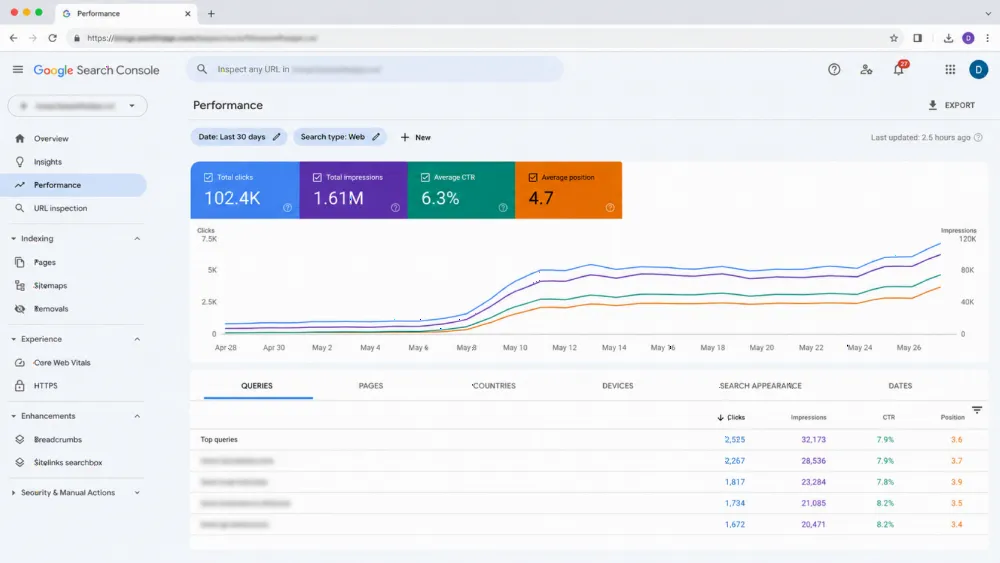
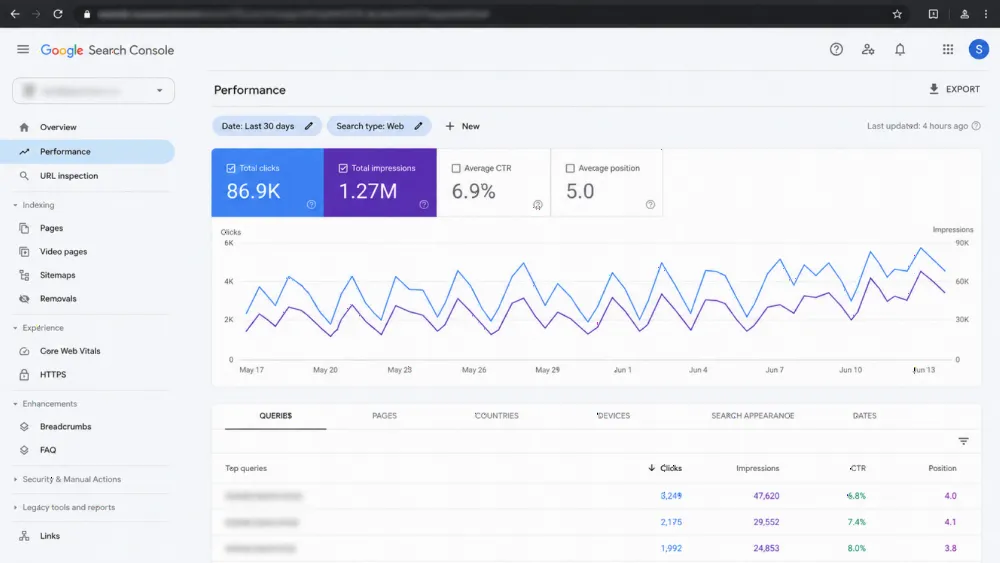
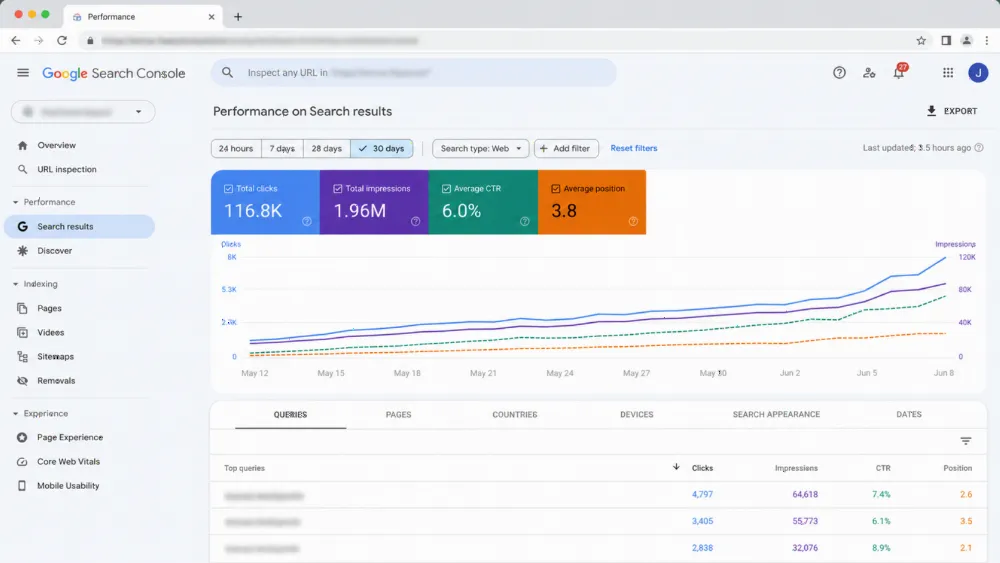
- An unchecked Search Console indexing report. The Coverage/Indexing report tells you exactly which pages Google refuses to index and why ("Crawled – currently not indexed" is the classic). Check it monthly.
- Rogue noindex tags. Migration and redesign leftovers —
<meta name="robots" content="noindex">on money pages — remove pages from results instantly. - Mass 404s from broken internal links. Some 404s are natural; hundreds of internal links pointing at dead pages burn crawl budget and frustrate users.
- Redirect chains and loops. A → B → C dilutes link equity and exhausts crawlers; A → B → A breaks the page entirely. Flatten every chain to a single hop.
- Missing canonical tags. URL parameters (sort, filters, session IDs) spawn thousands of duplicate URLs. Self-referencing canonicals on every page tell Google which version counts.
- Wasted crawl budget. On large sites, bots burn time on tag pages and internal search results while product pages go stale. Fence off low-value sections with robots rules.
- JavaScript rendering failures. Client-side React/Angular apps without server-side rendering can show Googlebot a blank page. Test with URL Inspection's rendered HTML.
- HTTPS misconfigurations. Mixed content, expired certificates, and redirecting chains on the secure version trigger browser warnings that kill trust and rankings.
Our technical SEO audit opens every engagement here — enterprise crawling, robots and sitemap cleanup, and rendering fixes — because this layer gates everything below. The full method lives in our 2026 technical SEO playbook for US websites.
Does your site pass the speed and mobile test? (Issues 11–18: Core Web Vitals & mobile)
Google indexes mobile-first and scores real-user field data. Over half the web still fails: the HTTP Archive Web Almanac 2025 found only 48% of mobile sites pass all three Core Web Vitals.
- Failing LCP (over 2.5s). The hero element paints too late — usually an unoptimized hero image or render-blocking CSS. See our Core Web Vitals launch checklist for the fix sequence.
- High CLS (over 0.1). Layout jumps from images without dimensions or late-injected banners cause mis-taps and lost conversions.
- Poor INP (over 200ms). Buttons and menus that lag after a tap — the metric that replaced FID and fails most "fast" sites.
- Desktop-only content parity. If the mobile version drops content, structured data, or internal links that desktop has, mobile-first indexing judges the thinner version.
- Unoptimized images. Multi-megabyte hero files on mobile connections are the most common LCP killer in small-business audits.
- Bloated CSS and JavaScript. Unused code blocks the main thread. Defer non-critical JS, purge unused CSS.
- Slow TTFB. Cheap shared hosting or unoptimized database queries delay every byte. Edge caching and query fixes usually halve it.
- Intrusive mobile interstitials. Full-screen popups covering content on load trigger an explicit Google penalty — redesign them as banners.
Speed is a revenue lever, not a vanity metric: Portent and Deloitte studies put each additional second of load beyond two seconds at roughly 7% lost conversions. That's why we build SEO-friendly from day one rather than optimizing after launch.
Is your on-page content helping or hurting? (Issues 19–30: content & on-page)
Crawlability gets you indexed; content gets you ranked. Ahrefs' famous crawl study found 96.55% of pages get zero traffic from Google — most content fails because of the issues below.
- Missing or duplicated title tags. Duplicates cannibalize; missing ones force Google to guess. Every indexable page gets one unique, keyword-led title.
- Weak meta descriptions. Not a ranking factor, but the ad copy that decides your click-through rate. Rewrite the top-traffic pages first.
- Keyword stuffing. Repeating the exact-match phrase fifty times triggers spam filters; modern ranking rewards natural semantic coverage.
- Thin content. Sub-300-word pages with no original insight are Helpful Content Update fodder. Expand, merge, or noindex.
- Broken heading hierarchy. Multiple H1s or headings used for styling confuse crawlers. One H1, then logical question-based H2s.
- Missing E-E-A-T signals. No author bios, no cited sources, hidden contact info — fatal for YMYL topics, damaging for everything else.
- Keyword cannibalization. Five pages targeting the same intent split your authority. Consolidate to one definitive page and redirect the rest.
- Missing image alt text. An accessibility failure that also forfeits Google Image Search traffic.
- Search intent mismatch. A sales page answering an informational query (or vice versa) will never rank — mirror the format the SERP rewards.
- Outdated content. "Best strategies for 2021" in 2026 signals an unmaintained site. Refresh dates, data, and screenshots.
- Walls of unformatted text. No headings, bullets, or tables means high bounce rates and low dwell time — engagement signals that compound.
- Unexploited content gaps. Competitors answer questions you don't. Gap analysis against the top three rivals per keyword cluster finds the missing pages.
Our content overhauls pair cannibalization cleanup with E-E-A-T upgrades — expert authorship, cited sources, original data. The no-retainer SEO agency model we run means you pay for the content work, not a monthly treadmill. The 2026 technical SEO playbook sequences these content fixes for US sites by expected revenue impact.
Can authority flow through your site? (Issues 31–38: architecture & internal linking)
Architecture decides how PageRank flows. A beautiful site with broken pathways is a dead end for bots and users alike.
- Excessive click depth. Key pages buried 4+ clicks from the homepage read as unimportant. Flatten to three clicks max.
- Orphan pages. Pages with zero internal links are rarely crawled and almost never rank. Every page needs at least one contextual inbound link.
- Lazy anchor text. "Click here" and "read more" waste ranking signals. Use descriptive, keyword-relevant anchors.
- Broken internal links. Internal 404s stop link equity dead and erode user trust. Crawl quarterly and fix.
- Chaotic URL taxonomy.
/p=1234&category=5URLs confuse bots and humans; clean/services/plumbing/pipe-repair/hierarchies do the opposite. - Missing breadcrumbs. They orient users and give Google a machine-readable hierarchy — plus eligibility for breadcrumb rich results.
- No internal linking strategy. Authority trapped in blog posts instead of flowing to service pages is the most common structural waste we see. Link from high-authority content down to money pages. The technical companion to this work is our Core Web Vitals and crawl-budget guide.
- Pagination errors. Mishandled rel attributes or page-2-to-page-1 canonicals can hide hundreds of products or posts from crawlers.
We map sites like urban planners: rescue orphans, build thematic silos, and funnel authority from the strongest pages to the highest-converting ones. Pair this with our Core Web Vitals and crawl-budget guide for the technical companion.
Does Google trust you locally and off-page? (Issues 39–46: local SEO & authority)
For US businesses serving geographic markets, local and off-page signals decide the map pack.
- Inconsistent NAP data. "Main St. Plumbers" on Yelp vs. "Main Street Plumbing LLC" on Facebook confuses local algorithms. Standardize everywhere.
- Unclaimed Google Business Profile. Unclaimed or photo-less GBPs with wrong categories forfeit the single biggest local ranking asset.
- No local landing strategy. Neighborhood pages, "near me" optimization, and local schema hand your backyard to competitors when skipped. Our local SEO maps system for US service businesses covers the full playbook.
- Toxic backlink profile. Legacy cheap link schemes (Fiverr comments, PBNs) cause algorithmic suppression that persists for years.
- No backlink monitoring. Without health checks, a negative-SEO attack can run for months unnoticed. Set up alerts and disavow promptly.
- No quality backlinks at all. Zero referring domains means zero authority to compete. Digital PR and original data earn the links that move rankings.
- Ignored reviews. Unanswered negative reviews — and low star ratings generally — signal poor service to Google and to buyers.
- Missing LocalBusiness schema. Without it, Google guesses your hours, coordinates, and business type instead of reading them.
Local trust compounds: consistent citations plus an optimized GBP plus genuine reviews is the map-pack formula that has worked for a decade and still does. See our services overview for how local SEO fits into our SEO, AEO, and automation engagements.
Do visitors convert once they arrive? (Issues 47–50: UX, schema & CRO)
Traffic is vanity; revenue is sanity. These four decide whether rankings pay.
- Missing rich-result schema. No FAQ, review, or product markup means forfeiting enhanced SERP real estate — star ratings and FAQ accordions measurably lift CTR.
- Confusing primary navigation. Jargon-heavy or overloaded menus bounce visitors before they reach a conversion page. Label menus in customer language.
- No clear CTAs. "Read more" is not a call to action. Every money page needs one primary, specific CTA above the fold.
- Unmeasured conversion leaks. Long checkouts, missing trust signals, and friction points only surface through behavior analysis. Watch session recordings; fix the biggest drop-off first.
This is where SEO meets CRO: we deploy custom JSON-LD, heatmap the friction, and redesign the pages our audits send traffic to. See how SEO-friendly development bakes conversion structure in from the start — and browse our case studies for what that looks like in production.
How do you measure whether the audit paid off?
Baseline before you change anything: organic sessions, keyword visibility, conversion rate, and customer acquisition cost. Then attribute revenue: a fixed crawl bug that recovers 200 sessions/month at a 2% conversion rate and $400 average order is $1,600/month — $19,200/year from one fix. An audit isn't an expense; executed in revenue order, it's among the highest-ROI line items in marketing. Clients typically start with a technical SEO audit and continue on no-retainer SEO — our case studies show the compounding effect.
Frequently asked questions
How often should a US business run a full SEO audit?
Quarterly for the technical and content layers, monthly for Search Console indexing and Core Web Vitals field data. Competitive US markets shift fast — a quarterly cadence catches redirect rot, content decay, and new cannibalization before they compound.
What's the difference between an automated audit and a professional one?
Automated tools flag symptoms (missing alt tags, slow pages) without context. A professional audit prioritizes by revenue impact and finds architectural problems bots miss — like cannibalization across five pages that each look "fine" in isolation. Use tools for scanning; use judgment for decisions.
Which of the 50 issues should I fix first?
Crawlability (issues 1–10) — nothing else matters if Google can't reach your pages. Then the revenue-adjacent items: title tags on top-traffic pages, LCP fixes, and cannibalization merges. Our 40 fixes we prioritize first is the short version of this list.
How long does it take to see results from an SEO audit?
Technical fixes (robots, sitemaps, redirects) typically move indexing within 2–4 weeks. Content and authority work compounds over 3–6 months — the average #1 ranking page is about five years old, so SEO rewards patience paired with consistent execution.
Can I do a 50-point audit myself?
You can run the checklist — it's designed to be self-serve. Most teams stall at prioritization and at the fixes requiring development access (rendering, architecture, schema). That's the usual point to bring in a technical SEO audit rather than let the findings sit in a spreadsheet.
Do Core Web Vitals really affect rankings?
Directly, modestly — page experience is a tiebreaker for content-comparable pages. Indirectly, enormously: slow pages convert worse (roughly 7% per extra second, per Portent/Deloitte), and poor engagement eventually drags rankings down with it.
Is local SEO included in a standard audit?
It should be for any business serving a geography — NAP consistency, GBP optimization, reviews, and LocalBusiness schema are frequently the highest-ROI items on the whole list. Purely national or e-commerce sites can weight issues 39–46 lower, but rarely to zero.
Stop guessing, start ranking. Work through the 50 issues above in order — or hand us the checklist and get a revenue-prioritized action plan back. Talk to our team for a fixed-scope audit with no retainer attached.