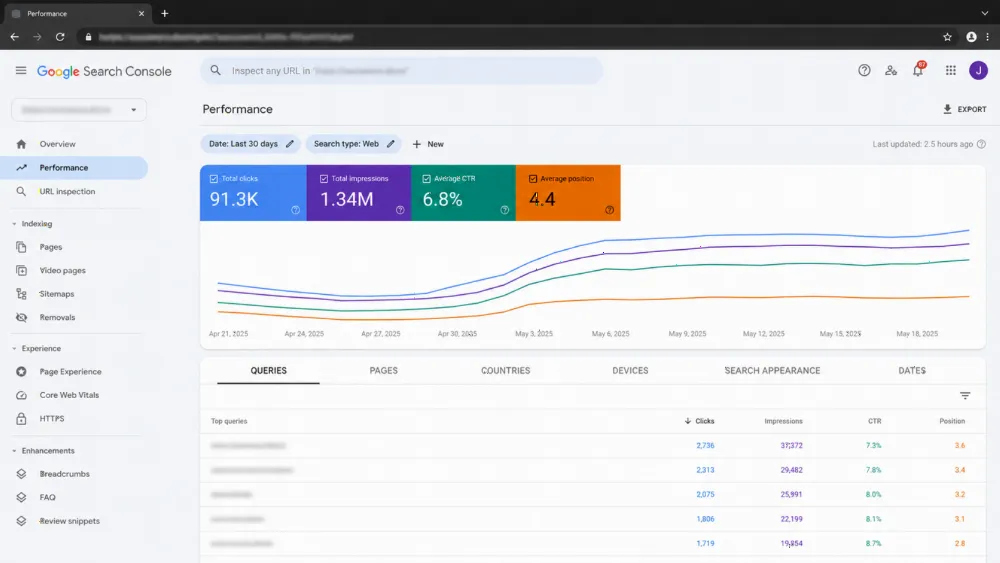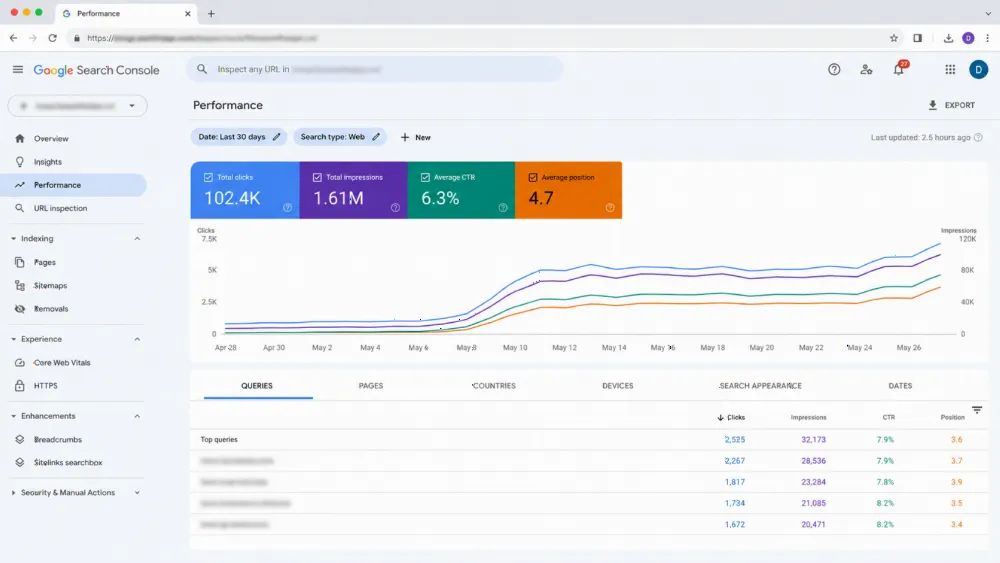
If your customers are in the UAE, use .ae. If your customers are in several countries, use .com. The reason is mechanical, not mystical: Google treats .ae as a country-code domain that is not on its list of "generic" ccTLDs, which means a .ae site gets automatic "this website targets the UAE" geotargeting. A .com, by contrast, is location-neutral and must prove its geography through hreflang tags, locale-specific URL structure, local content, and UAE-based signals like addresses, phone numbers, and backlinks. The extension itself is not a ranking score, but for a UAE-only business, the built-in geotargeting of .ae is the simplest possible way to tell Google who your site is for.
The 30-second decision rule
- All customers in the UAE → .ae. Automatic geotargeting, local trust, better name availability.
- Customers in several countries → .com with subfolders/subdomains per market plus hreflang.
- UAE first, expansion later → start on .com; register the matching .ae now and redirect it until you need it.
- Cannot meet .ae eligibility → .com with explicit UAE signals (see below).
.ae vs .com for SEO: the full comparison
| SEO factor | .ae (UAE ccTLD) | .com (gTLD) |
|---|---|---|
| Geotargeting signal | Automatic. Not on Google's generic-ccTLD list, so Google hard-codes it as UAE-targeted. | Manual. Location-neutral; needs hreflang, locale URLs, and local content signals. |
| UAE local-intent rankings | Built-in relevance for UAE queries — a head start on searches made from the Emirates. | Can rank equally well, but must earn relevance through content, GBP, and UAE backlinks. |
| Visibility outside the UAE | Limited. Geotargeting helps in the target country "at the expense of results in other locales" (Google). | Flexible. Can target multiple countries or stay global. |
| UAE user trust | Reads as local and legitimate; TDRA-regulated; ADNOC, Emirates NBD, and Careem lead with .ae. | Globally familiar, but can read as "foreign" next to a local competitor. |
| Registration rules | Restricted — may require UAE presence or a trade license. | Open to anyone, no geographic requirements. |
| Name availability | Much less crowded — short brandable names often still registerable at standard pricing. | Saturated; good names are taken, parked, or premium-priced. |
| Typical annual cost | Roughly AED 100–130 per year. | Roughly USD 10–20 per year. |
| Search Console setup | Nothing to configure — the ccTLD does it. | Rely on hreflang and URL structure; manual country-targeting was removed. |
How Google actually reads your domain extension
Google's Search Central doc on managing multi-regional and multilingual sites (read October 2026) lists the signals it uses to determine a page's target locale, in order:
- Country-code top-level domains (ccTLDs) — "provide a strong signal to both users and search engines that your site is explicitly intended for a certain country."
- hreflang statements in tags, headers, or sitemaps.
- Server location via IP address — "not a definitive signal," since CDNs distort it.
- Other signals — local addresses and phone numbers, local language and currency, links from local sites, and Google Business Profile.
The critical detail: Google treats some ccTLDs as generic (.tv, .me, .io, .co and about twenty others — it publishes the list) but .ae is not on it. A .ae domain gets automatic, unoverrideable UAE geotargeting with no configuration. This matters more than it used to, because Google removed the manual country-targeting setting from Search Console — there is no button left to declare "this .com is for the UAE." These signals are all you have.

What a .com has to prove instead
Nothing in Google's documentation says a .com is penalized in the UAE — it simply starts neutral. To win UAE queries with a .com, you supply the geography yourself: hreflang for en-ae/ar-ae variants (see our guide to SEO for bilingual Arabic/English websites), UAE addresses, +971 numbers, and AED pricing on the page, links from other UAE sites plus a verified Google Business Profile, and fast delivery via a CDN with UAE edge presence (server location is not a geotargeting signal, but Time to First Byte feeds Core Web Vitals). None of this is hard. It is just work that a .ae domain skips entirely on day one.
Where .ae wins: local search, trust, and availability
- Instant geographic relevance. For queries with UAE intent, a .ae domain arrives with its geography already declared. A .com must say the same thing with a stack of secondary signals — in competitive local SERPs, starting with the strongest signal is a genuine advantage.
- Trust and click-through. The .ae space is regulated by the UAE's TDRA, and the country's biggest names lead with it: adnoc.ae, emiratesnbd.ae, adib.ae, careem.ae. UAE searchers have clicked .ae results from trusted household brands for years, so a new .ae domain inherits a baseline of credibility — shoppers in Dubai and Sharjah read it as "one of ours."
- Name availability. The .com namespace is exhausted; the .ae namespace is not. Short, brandable names that would cost a fortune on the .com aftermarket are frequently still registerable on .ae at standard pricing.
- Built-in compliance signaling. Because .ae registration can require a UAE presence or trade license, the suffix quietly communicates "this is a real, licensed UAE business" — useful subtext in finance, legal, and healthcare.

Where .com wins: reach, scale, and flexibility
- Multi-country expansion. The moment you target Saudi Arabia, the UK, or the US alongside the UAE, .ae becomes a liability: Google warns that geotargeting helps the target country "at the expense of results in other locales." A .com with
/sa/,/uk/subfolders and hreflang keeps one brand and one authority pool across every market. - Link building at scale. International press and partners link to .com addresses without thinking; a .ae occasionally gets skipped by non-UAE editors who assume it is "only for the Emirates."
- Brand portability. If the business might pivot or expand internationally, .com is the universally recognized asset — and the one every voice assistant expects.
- No eligibility friction. .com is open to anyone; .ae may ask for a UAE trade license or local presence. If you need the site live before the license lands, .com removes a dependency. (Full registration picture: our .ae domain registration guide, covering .co.ae and the document requirements.)
What the extension does not decide
A few myths worth clearing up, because agencies on both sides oversell them:
- The extension is not a quality score. Google has never said a ccTLD outranks a gTLD on merit. A thin .ae site will lose to an excellent .com every time — the domain only decides the audience framing.
- Server location is (mostly) irrelevant. Google says it outright: with CDNs and modern hosting, server IP is "not a definitive signal." Host where it is fast; use a CDN with UAE edge presence for the speed benefit, not the geography signal.
- The death of google.ae changed nothing about .ae websites. In 2025 Google retired its own country-code search domains (google.ae now redirects to google.com), with results still personalized by location (Business Standard, April 2025). That was a change to Google's own product, not to how it treats .ae websites — your .ae domain still gets full ccTLD geotargeting.
The decision matrix: four real scenarios
- UAE-only service business (clinic, law firm, agency, restaurant) → .ae. Every customer is in the Emirates; automatic geotargeting and local trust are pure upside.
- Content site or SaaS with global ambitions → .com. A .ae would actively cap your international ceiling. Add the .ae as a defensive redirect.
Switching domains later: the SEO migration reality
Google treats a .com ↔ .ae change like any other site move — its guidance on TLD changes says moves are "treated the same as any other site move," with the advice to "choose a domain that will fit your long-term needs." The honest checklist:
- 1:1 301 redirects for every URL, not just the homepage. Our website redesign SEO migration checklist covers the full sequence.
- Update everything pointing at the old domain: sitemap, Google Business Profile, social bios, citations, paid campaigns.
- Expect turbulence — even a perfect migration shows ranking wobble for weeks. Never migrate right before a seasonal peak (Ramadan, White Friday, GITEX).
- Keep the old domain redirecting indefinitely — type-in traffic and old links live for years.

Brand protection: own both, lead with one
Whatever you choose as primary, register the matching domain in the other extension on day one — roughly AED 100–130 a year for .ae and USD 10–20 a year for .com (Choose Oxygen, read October 2026), the cheapest insurance in your marketing budget. 301-redirect the secondary to the primary, canonicalize to one version, and never run the same content on both. A competitor owning yourbrand.ae while you run yourbrand.com is a headache preventable for the price of a business lunch.
Frequently asked questions
Does a .ae domain automatically rank higher in the UAE than a .com?
No — Google does not use the extension as a ranking score. But .ae gives you an automatic UAE geotargeting signal (it is not on Google's generic-ccTLD list), which helps for queries with local intent. A .com can reach the same position; it just has to supply the geography through hreflang, local content, and UAE signals.
Can I register a .ae domain without a UAE trade license?
It depends on the registrant type and registrar policy — .ae is restricted compared with .com, and businesses may need to show a UAE presence or trade license. The .ae/.co.ae/.net.ae/.org.ae options and requirements are in our .ae domain registration guide.
Will a .ae domain hurt my rankings outside the UAE?
It can. Google states that geotargeting helps the target country "at the expense of results in other locales." If international traffic matters, use a .com with locale-specific URL structure and hreflang rather than making .ae your primary domain.
I already have a .com ranking in the UAE — should I migrate to .ae?
Usually not. If your .com already ranks and converts, the migration turbulence is not worth a geotargeting gain you can replicate with hreflang and local signals. Migrate only if the business is becoming UAE-exclusive and the brand benefits from the local suffix — as a full site migration with 1:1 redirects.
Can I use both — a .ae for the UAE and a .com for international?
You can, but it doubles your SEO workload and needs careful hreflang/canonical management to avoid duplicate content. Most UAE businesses are better served by one primary domain and the other as a 301 redirect — unless each region is a genuinely separate operation.
Conclusion: pick the domain that matches your customer map
The .ae vs .com question is really a business question wearing an SEO costume. UAE-only business → .ae for automatic geotargeting, local trust, and name availability. Multi-country business → .com with hreflang and locale structure, because .ae's geotargeting works in both directions. Register both extensions on day one, run one canonical site, and put the real effort where it compounds: content, technical health, and local authority.
Next step: the domain is a 30-minute decision; the website is the multi-year asset. If you are building a website in Dubai in 2026, WebStackRank will map the domain, bilingual structure, and SEO architecture before a single page is designed — fixed price from AED 990, proposal in 24 hours, and you own everything. Start with our UAE web development guide for 2026 costs, standards, and how to choose a partner.