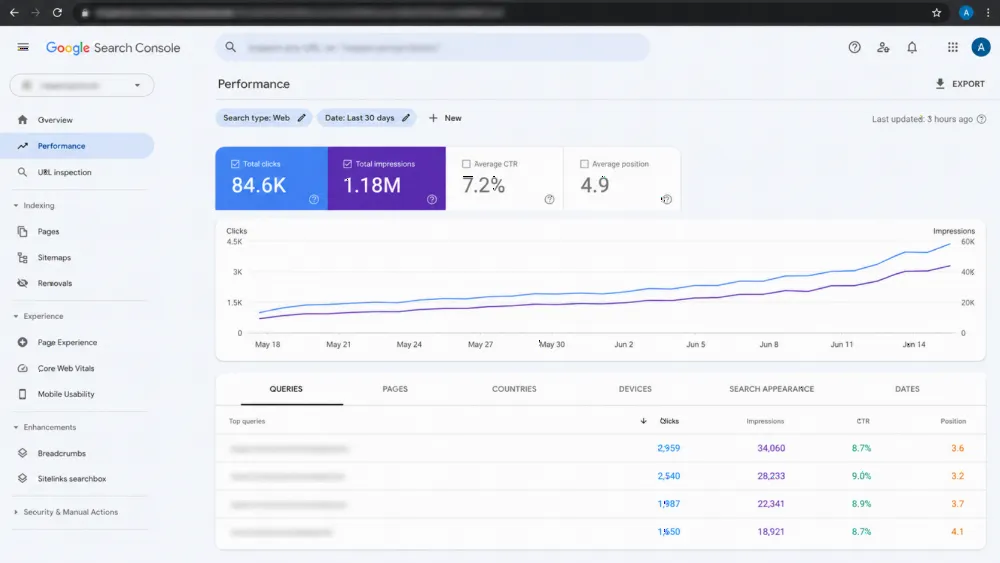
SEO wins a ranked link on a results page; AEO wins a mention inside the answer an AI gives. They're not rivals — AEO is an additional layer on top of solid SEO, not a replacement. Want traffic from Google and citations from ChatGPT and Gemini? You need both: SEO fundamentals first, AEO layered on top.
Wondering where you stand in AI answers today? Run our free AI visibility check and see which prompts already cite you.
What is the difference between AEO and SEO?
Definition. SEO (Search Engine Optimization) optimises your site to rank a URL on page one of search results — the goal is position and clicks. AEO (Answer Engine Optimization) optimises your content and presence to be cited, quoted or recommended inside the answer an AI assistant generates — the goal is mentions and share-of-answer across ChatGPT, Gemini, Perplexity and Google's AI Overviews. GEO (Generative Engine Optimization) is the broader term for the same job across all generative engines.
The honest difference. SEO and AEO optimise for two different moments in the customer journey. SEO fights for the click when someone scans a results page. AEO fights to be part of the synthesised answer when someone asks a full question and reads one response. Confusing the two is how budgets get wasted — you can rank perfectly well on Google and still be invisible at the exact second someone asks an AI which company to hire.
| Dimension | SEO | AEO / GEO |
|---|---|---|
| Goal | Rank a URL on page one | Be cited inside the AI's answer |
| Success metric | Position, clicks | Mentions, citations, share-of-answer |
| What wins | Keywords, backlinks, technical health | Fact density, first-hand expertise, entity authority, consensus |
| Where you compete | The Google results page | ChatGPT, Gemini, Perplexity, AI Overviews |
| Content unit | The page | The passage, the fact |
The complete AI visibility service we run for clients treats these as one system: the SEO foundation feeds Google's AI answers directly, while the AEO layer targets the chat engines' different rules.
When does each one matter?
SEO still matters — a lot. Roughly half of all searches still return classic blue links. And Google's AI Overviews are built on core Search ranking, so strong SEO directly feeds Google's AI answers: win normal Search and you feed Google's AI surface for free. Google's own May 2026 guidance confirmed that optimising for its AI features is still, fundamentally, SEO.
AEO matters for the other half of the journey. The discovery that now happens inside AI assistants — where a ranked link is worth nothing if you're not in the synthesised answer. The scale is moving fast: BrightEdge tracked AI Overviews appearing on roughly 48% of queries by early 2026, up from about 31% a year earlier, and Gartner projects traditional search volume could fall by around 25% by 2026 as buyers shift to AI assistants.
The sequencing. For a deeper measurement framework, our AI visibility audit checklist walks through how to baseline both surfaces. And if the technical floor is the weak point, a technical SEO audit finds the crawlability and structure issues that hurt both SEO and AI citation.
Do you actually need both?
Yes — and here's the allocation logic. Drop your SEO fundamentals to chase AI citations and you lose more than you gain: you sacrifice the half of searches that still show blue links, and you weaken the very foundation Google's AI answers are built on. Ignore AEO and you go missing from the fastest-growing surface in search.
The budget rule of thumb. For most businesses: 70% of effort on the SEO foundation that also feeds Google's AI answers (technical health, content depth, authority), 30% on the AEO layer for the chat engines (answer-first structure, entity consistency, brand mentions). Small businesses should start with the SEO foundation on their money pages, then layer answer-first content on top — they compound. Our guide on AEO for local businesses shows how this works at local scale.
How do you start with AEO?
Step 1 — Fix the technical floor. Your site must be crawlable, fast and indexable, and not accidentally blocking AI bots like GPTBot, OAI-SearchBot or PerplexityBot. This is a shockingly common failure we find in audits. Core Web Vitals and crawl-budget basics cover what "technically sound" actually means in 2026.
Step 2 — Restructure key pages answer-first. Put the buyer's actual question as a heading, then answer it in the first two sentences — self-contained sections that make sense lifted out of context, because that's exactly how AI engines pull them. Add a real FAQ.
Step 3 — Build entity authority. Keep your brand consistent everywhere: name, address, phone and service description identical across your Google Business Profile, directories and listings, backed by consistent schema. AI decides who you are from what the whole web says about you.
Step 4 — Measure prompts, not just keywords. Define the 20–30 questions your buyers ask an AI, run them weekly across ChatGPT, Perplexity and Gemini, and track how often you're cited. Share-of-answer is the metric that matters — not keyword rank alone. Our guide to getting ChatGPT to recommend your business goes deeper on the mention-earning side.
What actually gets you cited by AI?
The mechanism. When someone asks an AI a question, it rarely searches their exact words. It uses query fan-out — breaking the prompt into smaller searches — then retrieval-augmented generation to pull passages from across the web and stitch one answer. Three patterns decide who gets cited:
- Consensus beats claims. Models avoid inventing facts, so they trust what multiple independent sources repeat. One self-congratulatory page isn't enough — reviews, mentions and roundups feed the trust.
- Brand mentions matter. Citation analyses consistently find branded search volume among the strongest correlates of AI citation frequency. If people Google your name, AI recommends you more.
- Specifics beat marketing language. The KDD 2024 GEO study by Princeton, Georgia Tech, Allen Institute and IIT Delhi researchers found the right content techniques could lift AI-answer visibility by up to 40% — with statistics, cited sources and expert quotations as the biggest movers.
The 2026 honesty check. Google's May 2026 guidance named several hyped tactics as not required for its AI features: llms.txt files get no special treatment, "chunking" content into tiny AI-friendly pieces is unnecessary, AI-specific rewriting adds nothing, and schema is not an AI ranking signal (though it still earns classic rich results). That's why our llms.txt guide sets expectations carefully — it's a real file with real (limited) uses, not a citation shortcut.
FAQ
Is AEO replacing SEO?
No. About half of searches still show standard results, and Google's AI answers run on the same ranking systems as classic Search. AEO extends SEO; it doesn't replace it.
What's the difference between AEO and GEO?
Close cousins. AEO focuses on winning direct answers and snippets; GEO covers the broader job of getting retrieved and cited across generative engines. Most teams use the terms together and run them as one programme.
Which should a small business do first?
Start with the SEO foundation that also feeds Google's AI answers, then layer AEO — answer-first content and entity consistency — on your money pages. They compound.
How do I measure AEO success?
By share-of-answer: define the prompts your buyers ask an AI, run them weekly across ChatGPT, Perplexity and Gemini, and track how often you're cited. That's the metric that matters, not keyword rank alone.
Does schema markup help with AI citations?
For Google's AI features, independent tests show schema has little to no effect on citations — though it still earns rich results in classic Search. For ChatGPT and Perplexity, freshness, brand mentions and fact density matter far more.
Should I block AI crawlers from my site?
Almost certainly not, unless you have a specific licensing reason. Blocking GPTBot or PerplexityBot removes you from the retrieval pool those engines draw on — you can't be cited by an AI that can't read you.
How long before AEO work shows results?
Perplexity uses real-time retrieval and can reflect changes within weeks. Google AI Overviews track with your normal Search performance, so they move on SEO timelines — typically months.
The bottom line
AEO and SEO answer two different questions — "who ranks?" and "who gets cited?" — and in 2026 you need to win both. Build the SEO foundation first, then layer answer-first content, entity consistency and earned mentions on top, and measure prompts instead of just keywords.
Start with the free AI visibility check to see your baseline, then talk to us about the full programme — our GEO services turn that baseline into a share-of-answer you can track every week.
Written by the WebStackRank team — we run SEO and AI-visibility programmes for businesses in the UAE, GCC and USA. Last reviewed: October 2026.