If your buyers research through ChatGPT, Perplexity, Gemini, or Google's AI Overviews, the question is no longer "do we rank on page one?" — it's "do the answers cite us?" This 12-point audit scores every signal AI answer engines actually use, from crawler access to share-of-answer tracking.
The stakes are hard to overstate. BrightEdge tracking found AI Overviews now trigger on roughly 46–48% of Google searches (BrightEdge) (up 58% year over year), and only 17% of AI Overview citations come from pages ranking in the organic top 10 — classic ranking and AI citation are already diverging. Run this audit on your own site, score yourself out of 12, and anything below 8 means there's clear room to get cited more.
Want the technical half scored instantly? Our AI visibility check mindset starts with measurement — and you can talk to our team for a full scored audit of all 12 checks.
Are AI crawlers allowed on your site? (Checks 1–3: the technical floor)
1. Can GPTBot, OAI-SearchBot, PerplexityBot and ClaudeBot reach you?
Open your robots.txt and look for blocks on AI crawlers. If they're disallowed, you're invisible to those engines — and nothing else in this checklist matters. This is the single most common technical miss we find: a blanket Disallow copied from a 2019 template silently bans every AI crawler.
2. Is your site fast, semantic and crawlable?
AI engines parse the same DOM search engines do. Clean semantic HTML, fast loads, and no client-side rendering that hides content. If your key content only appears after JavaScript executes, some AI crawlers see an empty shell. Our Core Web Vitals launch checklist doubles as a crawlability checklist — the technical floor is shared.
3. Do you have an llms.txt?
A small Markdown file at /llms.txt pointing AI tools to your key pages, grouped by topic. It won't hack your way into citations — Google gives it no special ranking treatment — but writing one forces the content-and-crawler audit in checks 1 and 2. Read our full llms.txt guide for the exact format.
4. Is your Bing presence solid?
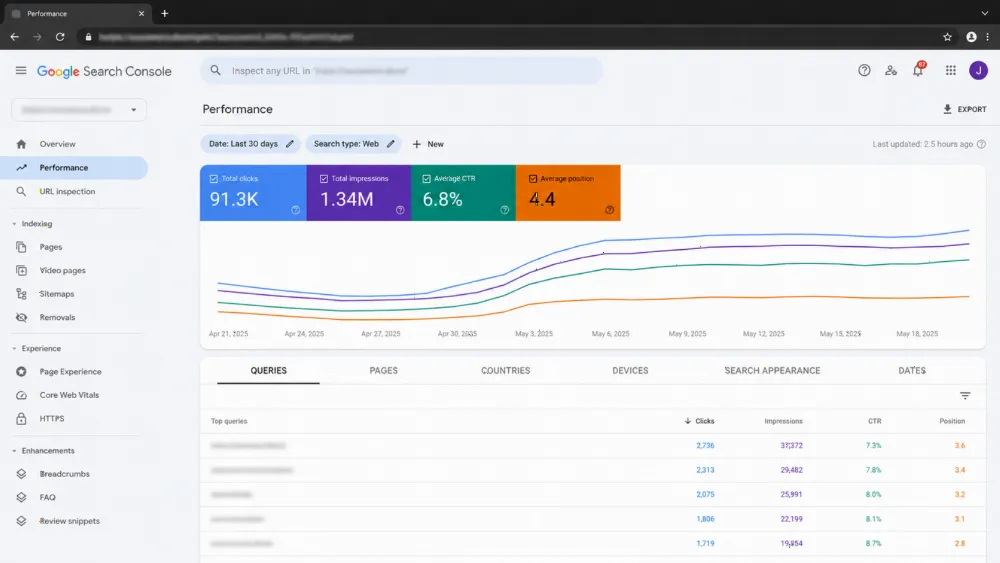
ChatGPT's search layer leans heavily on Bing's index. Submit your site to Bing Webmaster Tools and confirm your key pages are indexed there — not just in Google. Most teams audit only Google Search Console and miss that their money pages are absent from the index ChatGPT actually reads.
Is your content built to be cited? (Checks 5–8: content & structure)
Gartner's well-known projection put 25% of search traffic coming from non-traditional search by 2026 — and AI answers reward a different content shape than classic blue links. They lift self-contained, quotable passages.
5. Is every key page answer-first?
Put the buyer's question in the heading and answer it completely in the first two sentences. That passage should stand alone — no "as we discussed above" dependencies — so an AI can quote it verbatim without losing meaning.
6. Do you have genuine FAQ sections with schema?
FAQPage structured data on real buyer questions is one of the most-cited formats in AI answers. The questions must be ones customers actually ask (sales calls and support tickets are the source), not keyword-stuffed guesses.
7. Do you publish original, first-hand data?
At least one page carrying your own numbers — results, benchmarks, before/after measurements, pricing studies. AI engines quote specifics, not slogans. A paragraph with real figures beats ten paragraphs of adjectives, and it's nearly impossible for competitors to replicate.
8. Is your content multimodal?
Pages with genuine images, diagrams, and video get surfaced more often in AI answers; text-only pages compete with a hand tied behind their backs. A simple chart showing your own data doubles as both a citation magnet and a backlink magnet. For the strategy around this, see our guides on getting ChatGPT to recommend your business and GEO for SaaS companies.
Can AI engines identify and trust you? (Checks 9–11: entity & authority)
Here's the uncomfortable math: if only 17% of AI Overview citations come from the organic top 10 (BrightEdge), authority is being judged on signals beyond rankings — entity clarity and independent corroboration.
9. Is your entity schema in place?
Organization or LocalBusiness JSON-LD with consistent name, URL, logo, and sameAs links, so AI systems can confidently resolve who you are. Without it, you're a string of text; with it, you're an entity that can be cited with confidence.
10. Are your details consistent everywhere?
Name, services, and location identical across your site, Google Business Profile, and directories. Contradictions create doubt, and doubt gets you left out of answers. Citation audits catch what your own eyes miss — this is core to our local SEO ranking system for US service businesses.
11. Do independent sources mention you?
Reviews, "best in [city]" roundups, Reddit and Quora threads, YouTube mentions, podcast appearances. AI engines treat independent consensus as corroboration — it's the closest thing to a trust vote. Earned mentions beat anything you publish about yourself. For the technical foundation underneath, our technical SEO audit verifies entity schema and citation consistency across the web.
Are you measuring any of this? (Check 12: the loop)
12. Are you tracking share-of-answer?
Pick 20–30 buyer-intent prompts and run them weekly across ChatGPT, Perplexity, and Gemini, logging who gets cited for each. Without this you're optimizing blind — the AI-search landscape shifts with every model release. Watch release notes the way you watch Search Central updates: SE Ranking found a single model upgrade reshuffled 42% of previously cited domains (SE Ranking), nearly all of them long-tail sites. We automate this tracking loop with AI marketing-operations workflows; clients on no-retainer SEO get share-of-answer reporting built in.
What to do with your score
- 10–12: You're ahead of most of the market. Keep the weekly tracking and refresh FAQs quarterly.
- 8–9: The foundation is there; close the remaining gaps in order — crawlers, then content, then entity.
- Below 8: Clear room to get cited more. Start with checks 1–4 (the technical floor) since they gate everything else.
Our team implements the full checklist — from technical SEO audits that fix the crawl floor, to custom GPT and AI automation builds that put your content where AI systems actually look, to the ongoing measurement loop in check 12. If you want ChatGPT recommending your business specifically, our guide on how to get ChatGPT to recommend your business pairs with this audit.
Frequently asked questions
How often should I run an AI visibility audit?
Run the full 12-check audit quarterly, and track share-of-answer weekly. The AI-search landscape shifts with every model release — one model update reshuffled 42% of cited domains in SE Ranking's study (SE Ranking) — so quarterly is the minimum cadence that keeps you current.
What's the single biggest miss on most sites?
Accidentally blocking AI crawlers in robots.txt. It's check 1 for a reason: a single Disallow can make you invisible to GPTBot and friends while your Google rankings look perfectly healthy. Weak Bing coverage is the runner-up — ChatGPT's search leans on Bing, not Google.
Can I do this audit myself?
The technical checks (1–4), yes — start with robots.txt, Bing Webmaster Tools, and an llms.txt file; our llms.txt guide covers the file setup in detail. The content, entity, and measurement work is where most businesses bring in help, because it requires editorial judgment and ongoing tracking discipline.
Does ranking #1 on Google guarantee AI citations?
No — and this is the finding most teams miss. BrightEdge found only 17% of AI Overview citations come from pages ranking in the organic top 10. AI engines weigh answer-first formatting, original data, and entity corroboration alongside (and sometimes above) classic rankings.
Which AI engine should I optimize for first?
Optimize the fundamentals that all of them share: open crawlers, fast semantic pages, answer-first content, entity schema, and independent mentions. Engine-specific quirks change monthly; the 12 checks in this audit have been stable across ChatGPT, Perplexity, Gemini, and AI Overviews.
How long before I see citation improvements?
Technical fixes (crawler access, llms.txt, Bing indexing) can show movement in 2–4 weeks. Content and authority signals — original data pages, third-party mentions, consistent citations — compound over 2–3 months. Weekly share-of-answer tracking is how you see it happening.
Is AI visibility separate from SEO?
It's an extension of it. Organic search still drives about 53% of trackable website traffic (BrightEdge) (BrightEdge), so classic SEO isn't going anywhere. AI visibility adds the citation layer on top: same technical floor, plus answer-first formatting, entity clarity, and measurement of who the answers quote.
Score yourself, then act on it. If you scored below 8 — or you'd rather have the full 12 checks implemented for you — talk to our team. We run the technical fixes, write the answer-first content, and set up the tracking loop.