AED

Retail & e-commerce

Retail & e-commerce website design in Dubai

Online stores and retail brand sites for UAE shops, boutiques, grocers and direct-to-consumer brands — catalogue, one-page checkout with UAE payment gateways, cash on delivery and buy-now-pay-later, delivery zones, click-and-collect and an Arabic storefront, on Shopify, WooCommerce or custom.

  • One page checkout, guest by default
  • AED cards, COD, pay-later
  • EN + AR storefront
  • Fixed price no retainers

Quick answer

How much does an online store cost in Dubai, and how long does it take?

A Shopify store with a custom theme, apps, a UAE payment gateway and multi-currency set-up starts from ≈ AED 5,142 for around 25 products and launches in about 3 weeks. A full-feature WooCommerce or Medusa store starts from ≈ AED 9,181 for around 30 products in about 5 weeks. A retail brand site without a checkout — catalogue, branches, WhatsApp ordering — fits the Small Business Website at AED 2,490. Every project is a fixed price with 3 months of free maintenance; large catalogues, POS and ERP sync are quoted on a fixed scope.

≈ AED 5,142
from — Shopify store, ~25 products
≈ AED 9,181
from — full WooCommerce / Medusa store
3-10 wks
test orders before opening

Why it matters

UAE shoppers buy on a phone, expect delivery tomorrow, and abandon a slow checkout

E-commerce in the UAE has its own habits: most orders are placed on a phone, cash on delivery is still a common choice next to cards and instalments, same-day delivery inside Dubai is expected rather than special, and a large share of shoppers browse in Arabic. A store that is built for those habits converts; one imported from a template built for another market leaks orders at the checkout.

The product page, not the homepage, is the conversion engine: several images, a short video where it helps, the price in AED with VAT included, stock and delivery date, sizes and variants, real reviews, a sticky add-to-cart button. Then a cart that shows the free-delivery threshold and a checkout that fits one scroll — guest by default, address autocomplete, every payment method a UAE customer expects.

Marketplaces bring discovery and keep the customer. Your own store carries the full range, the bundles, the brand story and the returning customer who converts at several times the rate of a first visit — and a bilingual store with its own Arabic search presence reaches the half of the market that researches in Arabic.

  • One-page checkout
  • Cards, COD, pay-later
  • Delivery zones
  • Click-and-collect
  • Arabic storefront
  • Product feeds
  • WhatsApp order updates

Common problems

Why online stores in the UAE lose orders

The four gaps we fix most often for retailers, boutiques, grocers and direct-to-consumer brands.

  1. Marketplace-only, no store of your own

    Everything sells through marketplace listings: the margin, the customer data and the brand belong to the platform. A fee change or a ranking change can halve the business overnight, and there is nowhere to send a returning customer.

  2. A checkout that asks for an account and offers one way to pay

    Create an account, type the address, pay by card only. UAE shoppers who wanted cash on delivery, instalments or Apple Pay leave at the last step — the most expensive place to lose them.

  3. Product pages that load slowly on a phone

    Full-size images, a dozen apps and a heavy theme. On a 4G connection the page takes seconds, the shopper is gone, and Google ranks the product lower for the same reason.

  4. No Arabic storefront, no local delivery logic

    An English-only store with a single flat delivery rate ignores the Arabic-speaking shopper and the Dubai customer who expects same-day delivery in their area — and shows an Abu Dhabi customer an option that does not exist.

Must-have features

Six things a UAE online store must do

The features retail owners and e-commerce managers ask for first — and where each one fits in our fixed-price packages before an integration is scoped.

  • A catalogue shoppers can navigate in two clicks

    Categories and filters that match how customers think — price, size, colour, brand — search with autocomplete and typo tolerance, and collection pages that stay fast with hundreds of products.

    Fits: Shopify Store from ≈ AED 5,142
  • Product pages that sell

    Several images, a short video where it helps, the AED price with VAT included, stock and delivery date, variants, real reviews, a sticky add-to-cart and product schema for rich results — the page that carries most of the conversion.

    Fits: every store build
  • One-page checkout with UAE payments

    Guest checkout by default, address autocomplete, a UAE-local gateway or international cards with 3-D Secure, Apple Pay and Google Pay, cash on delivery and buy-now-pay-later — all on one page, in AED.

    Fits: E-Commerce Store from ≈ AED 9,181
  • Delivery zones and click-and-collect

    Rates and cut-off times by emirate or area, same-day and next-day options where your courier supports them, free-delivery thresholds, collection at your branches and a returns flow that needs no phone call.

    Fits: scoped with the store build
  • An Arabic storefront and AED pricing

    A proper right-to-left store in Arabic — categories, products, cart, checkout, emails and WhatsApp updates — with prices in AED and the customer's currency shown as an approximation for visitors from abroad.

    Fits: Shopify Store and up
  • SEO, feeds and the second visit

    Product, review and breadcrumb schema, category pages that rank, buying guides, product feeds for Google Shopping, social catalogues and marketplaces — and saved carts, order tracking and reorder for the returning customer who converts best.

    Fits: SEO sprint from ≈ AED 6,611

Who we build for

Stores — tuned to what you sell

The same catalogue, checkout and delivery logic — configured for the way your range actually sells.

  • Fashion & modest wear

    Fashion & modest wear

    Sizes, variants, lookbooks, returns, seasonal drops — abaya and modest-wear stores are a UAE speciality

  • Beauty & perfume

    Beauty & perfume

    Shade and size variants, bundles, subscriptions, samples

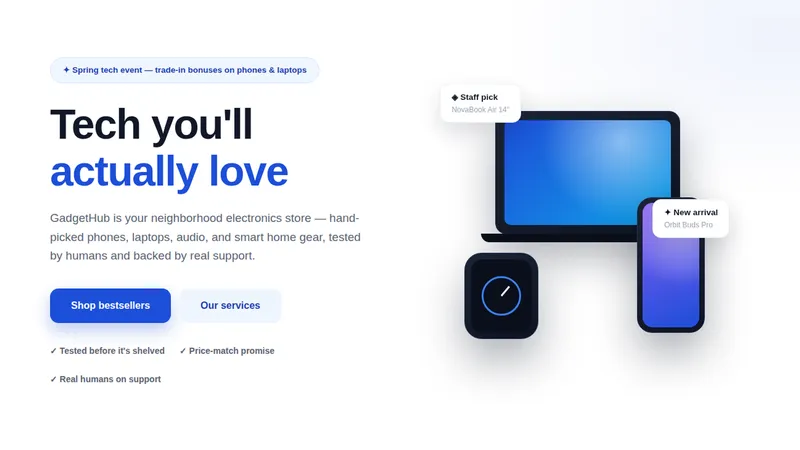
  • Electronics & gadgets

    Electronics & gadgets

    Specifications, comparisons, warranty, instalments

  • Grocery & food

    Grocery & food

    Delivery slots, substitutions, weights, same-day zones

  • Home & furniture

    Home & furniture

    Room pages, dimensions, delivery and assembly, showrooms

  • Footwear & sports

    Footwear & sports

    Size guides, stock by store, pre-orders, exchanges

  • Pharmacy & health retail

    Pharmacy & health retail

    Prescription handling, repeat orders, branch collection

  • Boutiques & concept stores

    Boutiques & concept stores

    Small curated catalogues, WhatsApp ordering, branch pages

Integrations

Plays nicely with the systems your shop already runs

No rip-and-replace. The store plugs into the payment, delivery, stock and messaging tools you use today.

Payment gateways & pay-laterUAE-local gateways or international cards with 3-D Secure, Apple Pay and Google Pay, cash on delivery and buy-now-pay-later providers, all in AED

Couriers & deliveryOrders pushed to your courier through its integration or a daily manifest, tracking returned to the customer, COD remittance reconciled

POS, inventory & ERPStock by branch, prices and orders kept in sync with the point-of-sale or ERP you already run, so the store never sells what the shop just sold

WhatsApp Business APIOrder confirmations, delivery updates, abandoned-cart reminders and support from your verified number

Product feeds & marketplacesGoogle Shopping, social catalogues and marketplace feeds generated from the store, so a product is updated once and published everywhere

Email, reviews & loyaltyReview requests after delivery, win-back and reorder emails, loyalty points and gift cards from the customer data you now own

How it runs

How an online store project runs

Six steps, in the order we run them on every retail build — the checkout first, because that is where orders are won or lost.

  1. Catalogue & channel audit

    We map your range, variants and stock, where you sell today — shop, marketplaces, social — your courier, gateway and POS, and your margins by category, so the platform choice and the payment mix are decided on numbers.

  2. Products, photos & Arabic

    Products, prices with VAT, variants, policies and buying guides go into one structured source in English and Arabic. We plan the product photography and compress every image so pages stay fast on a phone.

  3. Checkout-first design

    Wireframes and a visual design built around the product page, the cart and a one-page checkout — mobile first, because most orders arrive from a phone, social or a search.

  4. Build & integrations

    Shopify, WooCommerce or Medusa build with the payment gateway, pay-later, courier, POS or ERP and the WhatsApp Business API connected and tested with real test orders through the real gateway.

  5. Launch & test orders

    Soft launch with test orders from each payment method and each delivery zone, returns tested end to end, then the store opens — with the marketplace listings kept in sync through feeds.

  6. SEO, feeds & support

    Product and category schema, Google Shopping and social feeds, analytics on which products, channels and areas bring the orders, and 3 months of free maintenance after launch.

Pricing

Fixed price — no monthly retainers

A Shopify store with a custom theme, apps, gateway and multi-currency starts from ≈ AED 5,142. A full WooCommerce or Medusa store with checkout, shipping zones and payments starts from ≈ AED 9,181. A retail brand site without a checkout fits the Small Business Website at AED 2,490. Large catalogues, POS and ERP sync and custom storefronts are quoted on a fixed scope.

≈ AED 5,142
from — Shopify store, custom theme, ~25 products
≈ AED 9,181
from — full WooCommerce or Medusa store, ~30 products
AED 2,490
retail brand site: catalogue, branches, WhatsApp orders

Smaller start

A single boutique, a home-based brand or a shop that takes orders on WhatsApp can begin with the One-Page Website Launch at AED 990 (range, prices, WhatsApp ordering, branch, map), with 3 months of free maintenance, then add the full store as the next stage.

UAE notes

What is different about an online store in the UAE

Four things we build in from the start on every retail project here.

  • Every payment method a UAE shopper expects

    Cards through a UAE-local gateway or international acquirer with 3-D Secure, Apple Pay and Google Pay, cash on delivery with a courier that remits it, and buy-now-pay-later instalments — shown as plain choices on one checkout page, in AED.

  • VAT included, prices in AED

    The 5% VAT is shown inside the price, not added at checkout, and an invoice with your tax registration number goes out with every order. Visitors from abroad see their currency as an approximation; the charge stays in AED.

  • Delivery that matches the map

    Rates and cut-offs by emirate or area, same-day inside Dubai where your courier supports it, click-and-collect at branches and a returns policy stated before the order — the promises UAE shoppers compare before they buy.

  • Licensed to sell online

    Online sales need the right activity on your trade licence — a Dubai DET e-trader licence for home-based sellers, or the e-commerce activity on a mainland or free-zone licence for shops; we add the licence number, return policy and contact details the gateways and marketplaces look for, and keep them consistent across the store and your profiles.

FAQ

Common questions from retail owners

Straight answers on cost, platforms, payments, delivery, timelines, Arabic and marketplaces.

How much does an e-commerce website cost in Dubai?

A Shopify store with a custom theme, apps, a UAE payment gateway and multi-currency set-up starts from USD 1,400 (≈ AED 5,142) for around 25 products. A full-feature WooCommerce or Medusa store with checkout, shipping zones and payments starts from USD 2,500 (≈ AED 9,181) for around 30 products. A retail brand site without a checkout — catalogue, branches, WhatsApp ordering — fits our Small Business Website at AED 2,490. Large catalogues, ERP and POS integrations and marketplaces are quoted on a fixed scope after a free call.

Shopify or WooCommerce for a UAE store?

Shopify when you want the lowest operating overhead, a fast launch and a team that will not touch code — it handles hosting, security and updates, and UAE payment and shipping apps are mature. WooCommerce when your brand already lives on WordPress, you want full control of the checkout and content, or the catalogue has unusual rules. We build both and recommend the one that fits your catalogue, team and growth plan, not the one that is easiest for us.

Can customers pay by card, cash on delivery and buy-now-pay-later?

Yes. We connect a UAE-local payment gateway or international cards with 3-D Secure, Apple Pay and Google Pay, cash on delivery with a courier that remits COD, and a buy-now-pay-later provider for instalments — all shown as choices on a single checkout page in AED. Which combination makes sense depends on your average order value and margin; we work it out in the first call.

How does delivery work — same day, zones, click-and-collect?

Delivery zones by emirate or area with their own rates and cut-off times, same-day or next-day options where your courier supports them, free-delivery thresholds, click-and-collect at your branches, and a returns flow that does not need a phone call. Orders go to your courier through its integration or a daily manifest, and the customer gets tracking on WhatsApp and email.

How long does an online store take to launch?

A Shopify store with around 25 products launches in about 3 weeks after we receive your products, photos and policies. A full WooCommerce or Medusa store takes about 5 weeks. Add POS or ERP sync, a large catalogue or an Arabic storefront and most projects launch in 6–10 weeks. We go live with test orders through the real gateway and courier before the store opens to customers.

Will the store work in Arabic?

Yes. The Arabic storefront is a proper right-to-left store — categories, product pages, the cart, checkout, emails and WhatsApp updates all exist in both languages, with Arabic search engine optimisation of its own. Prices stay in AED with the guest's currency shown as an approximation, and Western digits, Arabic typography and LTR-isolated prices and phone numbers are handled in the theme from the start.

Can we keep selling on Amazon and Noon and still run our own store?

Yes, and most brands should. The marketplaces stay for discovery; your store carries the full range, the brand story, bundles and the customer relationship at full margin. Product feeds keep the catalogue in sync with the marketplaces, Google Shopping and social catalogues, so a product is updated once and published everywhere.

How do I choose an e-commerce agency for a UAE store?

Ask for stores they launched with COD, Tabby/Tamara and a UAE gateway live, an Arabic storefront you can click through, delivery zones by emirate, and the fixed price in writing with the product count included. Make sure the store, domain and customer data are yours.

Related Services

From the Blog

Guides and insights to help you plan your web design, development and SEO project.

Sell on your own domain.

Tell us about your range and we will send a tailored proposal — platform, checkout, payments, delivery and a fixed price — within 24 business hours.

Get a free quote

An itemised proposal within 24 business hours. No generic decks, no pushy calls.

No subscriptions, no spam. We reply within 24 business hours.