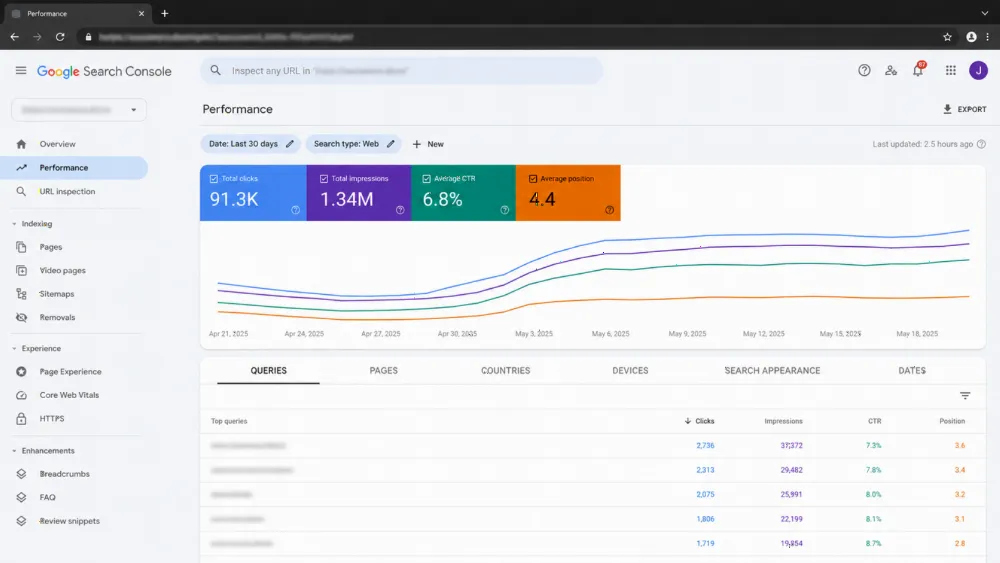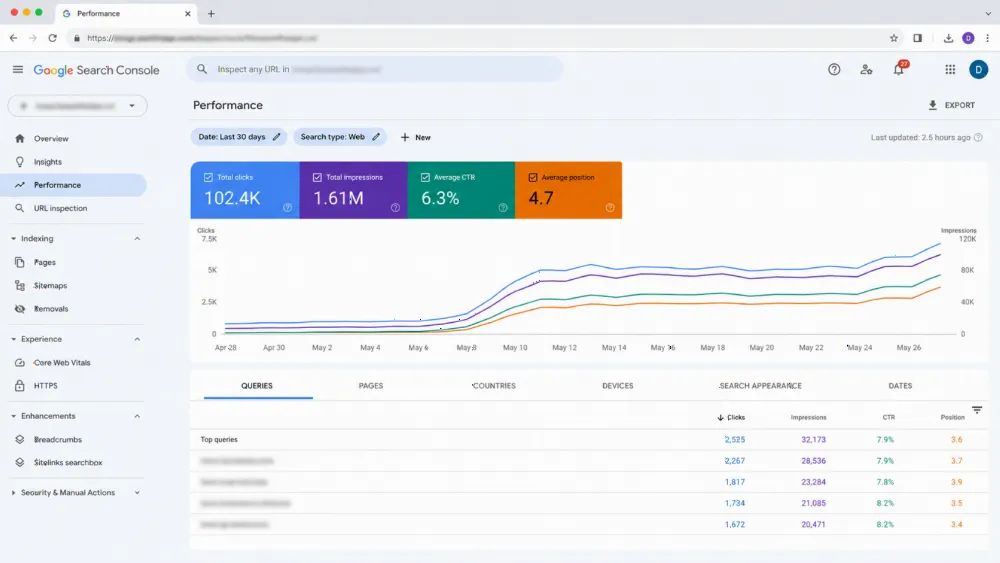
Do not let a redesign copy every old page across by default. Before design starts, put every URL in a spreadsheet, judge it on Search Console clicks and impressions, enquiries or conversions, backlinks and intent, and give it one verdict: keep, update, merge or kill. Pages earning traffic, links or enquiries survive. Pages chasing the same intent as a stronger page merge into it. Pages with no traffic, no links, no conversions and no distinct job are killed — with a redirect to the closest relevant page, or a clean 410 where nothing relevant exists. Those verdicts, plus a redirect map, become the redesign brief.
The short answer: every page gets one of four verdicts before design starts
The four verdicts cover every case. Keep means the page survives, unchanged or lightly refreshed, at the same URL wherever possible. Update means the job is still needed but the content no longer does it — outdated services, prices or advice — so it is rewritten in the redesign. Merge means two or more pages chase one intent; the strongest survives and the others redirect into it. Kill means the page has no defensible job left. No page stays undecided: an undecided page is one the designer will copy by default, which is exactly the failure this audit prevents. Decide the refresh, redesign or rebuild scope first if you have not already; the audit runs inside whichever scope you chose.

The problem: a redesign that copies everything imports the old site's damage
A redesign budget is finite, and every copied page spends some of it: design, migration, testing and future maintenance. Sites accumulate duplicate service pages written for slightly different phrases, campaign pages from offers that ended long ago, archives nobody visits, and blog posts competing for the same query. Copying them all across does not preserve value — it preserves the problems, in a more expensive skin. Worse, an unaudited migration changes URLs with no record of what each old page was for or where its visitors should now land. The audit spends the budget only on pages that deserve to exist.
Build the inventory: the columns your spreadsheet actually needs
Export every indexable URL from your sitemap and a crawl, then add the columns below — one row per URL, including Arabic versions. Freeze content changes once the audit starts, so the evidence stays stable.
| Column | What to record | Why it matters |
|---|---|---|
| URL and template | Full URL; page type (service, blog, landing) | Template families share verdict patterns |
| Intent and main query | The job of the page; top Search Console query | Exposes pages chasing the same intent |
| Traffic | Clicks and impressions, last 12 months | Seasonal pages need a full year to judge fairly |
| Business value | Enquiries, conversions or assisted value in GA4 | Low-traffic pages can still earn their place |
| Links | External backlinks and internal links in | Linked pages cannot simply vanish |
| Verdict and target | Keep, update, merge or kill; redirect target if not kept | Becomes the redirect map and new sitemap |
Resist adding more columns; a completed inventory beats a perfect template abandoned at row forty.
The evidence for each page: clicks, conversions, backlinks and intent
Judge each page on four kinds of evidence, in this order. First, search performance from the Search Console Performance report: clicks, impressions and the queries each URL ranks for, over twelve months so seasonal services are judged fairly. Second, business value from GA4: enquiries, calls or conversions the page starts or assists — a modest-traffic page producing enquiries outranks a high-traffic page producing none. Third, links: external backlinks and internal links pointing at the page, which represent value and breakage risk if the URL disappears. Fourth, intent: the single job the page does, and whether another page does it too — the cannibalisation test. Never kill on low clicks until conversions, links and intent have also been checked.
Keep: the tests a page must pass to survive unchanged (or refreshed)
A page earns Keep when it has a distinct intent no other page serves better, evidence that intent matters — clicks, conversions or valued backlinks — and content still accurate. Keep its URL wherever possible; a stable address carries rankings and links across with the least risk. Light refresh is part of Keep: update dates, prices and examples in the new design without changing what the page is for. Mark any Keep page whose template performs poorly — against the Core Web Vitals thresholds of LCP at or below 2.5 seconds, INP at or below 200 milliseconds and CLS at or below 0.1 — so the redesign fixes the template, not the content. List your top pages by clicks and conversions at the top of the brief, so nobody restructures them casually mid-project.
Merge: when two pages chase one intent — and how to pick the survivor
Merge when two or more pages target the same intent and split the evidence: neither ranks as well as one combined page could, and visitors meet near-identical content at two addresses. Pick the survivor on evidence, not seniority: stronger clicks and rankings for the shared queries, better backlinks, and the URL best matching the intent — weighing conversions where pages produce them. Move unique, useful material from the losers into the survivor, then redirect each loser directly to it at launch. Record the target in the inventory; "merge" without a named survivor is a wish, not a verdict. Do not merge genuinely different intents that merely share words — a service page and a cost guide should both live, cross-linked. Our guide to web content development covers how the survivor should then be written.

Kill: when deletion (with a redirect, or a clean 410) is the honest call
Kill a page when, after the evidence check, it has no clicks worth protecting, no conversions, no meaningful backlinks and no distinct intent — or when its content is actively harmful: services you no longer offer, prices you no longer charge, advice you would not stand behind. Dead campaign pages, empty archives and thin duplicates usually land here. Each killed URL needs a launch treatment: redirect it to the closest genuinely relevant survivor where one exists. Where nothing relevant exists, let it return a proper 404 or, for a deliberately removed page, a 410 — rather than redirecting unrelated traffic to the homepage, which helps nobody. Note the treatment per URL; "delete" alone is not an instruction a developer can safely execute.
The Dubai/UAE duplication trap and the EN/AR pair check
Two duplication patterns are especially common on UAE sites. The first is the geographic twin: a "Dubai" version and a "UAE" version of the same service page, now splitting clicks. Run the pair through the merge test — shared queries, intent and content — and usually keep the page matching how the business actually sells, merging the twin into it. The second is pair drift between English and Arabic versions: the English page was updated, the Arabic page still carries old services and prices. Audit EN/AR pairs together: if the English verdict is Update, the Arabic version needs the same update or an explicit decision to retire it. Where the audit changes redesign cost, our guide to how much a website costs explains the drivers.
Turn verdicts into the redesign brief: new sitemap + redirect map
The audit only pays off as build instructions. From the finished inventory, produce two documents. The new sitemap lists every Keep, Update and Merge-survivor URL as it will exist on the new site — the designer's page list. The redirect map lists every URL merging, moving or being killed, with its exact destination or 404/410 treatment — the developer's launch checklist. Agree both before design starts, price against them, and use a fixed-price structure so killed pages visibly reduce scope. After the audit, follow our website redesign SEO migration checklist for the launch sequence, and the guide on redesigning without losing rankings for its protections.

Common mistakes
The costliest mistake is deleting on traffic alone: a low-click page may hold the backlinks, the enquiries or the only accurate service description. Next is merging different intents because titles sound similar. Other frequent errors include auditing without a content freeze; keeping every page "just in case"; naming no survivor or redirect target, so merges never happen; forgetting Arabic versions in the inventory; and skipping the redirect map until launch week.
FAQ
When should I do a content audit — before or after choosing a redesign scope?
Before design starts, ideally before the redesign is priced. Choose the scope first — refresh, redesign or rebuild — then audit inside it. Quotes priced before the audit price pages that should be merged or killed.
How do I decide between merging pages and deleting them?
Merge when another page serves the same intent and can absorb the content and redirect. Delete — kill — when no page shares the intent and the page itself has no traffic, conversions, links or distinct job worth keeping. Intent decides first; traffic confirms.
Will deleting pages hurt my Google rankings?
Deleting a page with no rankings, traffic or backlinks removes nothing Google was rewarding. The risk is deleting pages that do carry clicks, links or conversions, or deleting without redirects where a survivor exists. Evidence first, then a redirect or a clean 404/410, is the safe sequence.
What do I do with Dubai and UAE versions of the same service page?
Test the pair for shared queries, shared intent and near-identical content. In most cases keep the stronger, better-matching page as the survivor, move any unique material into it, and redirect the twin to it at launch. Keep both only if they genuinely serve different intents.
What should the redirect map contain before launch?
Every old URL that will not survive unchanged, its verdict, and its exact treatment: the destination URL for merges and moves, or 404/410 for kills with no relevant target. One row per URL, agreed before launch, and tested after it.
Have the audit run before your redesign is scoped (CTA)
If your redesign is about to be quoted page-for-page from the old site, pause it for the audit: the verdicts usually shrink the scope and protect the pages carrying your enquiries. Talk to our web design company in Dubai team with your current sitemap, and have the decisions made before design begins.