

Visitors know their task, not the taxonomy
Someone wants to check a draft, cite a source or shorten an article. The directory has to translate those jobs into tools in one step, on a phone, without a tutorial.
AI product engineering · SaaS
FiftyGPT brings AI detection, humanising, paraphrasing, summarising, grammar, translation, academic planners and everyday utilities under one roof: 105 free tools at the time of writing. The product question was never how many tools fit on a homepage. It was how quickly someone finds the right one and understands what it can and cannot promise.
AI agent & GPT developmentProject overview
FiftyGPT is a web platform where a visitor pastes text, picks a job and gets a result: check whether a draft reads as machine-written, rewrite stiff prose, paraphrase, summarise, fix grammar, translate, count words, or plan a personal statement. The homepage leads with the AI detector; a directory page organises the full catalogue of 105 tools by what the visitor is trying to do.
The audience is mostly students and writers who arrive with a task, not with knowledge of the site's taxonomy. A site with five tools is easy to navigate. A site with more than a hundred is a different product, and the information architecture becomes the feature: search, task-led groups, consistent tool pages and related-tool clusters.
The second product decision is about honesty. AI text detection is probabilistic. FiftyGPT's detector explains sentence-level signals and the risks of short passages rather than printing a single confident percentage, and the plagiarism tool says plainly that a search provider must be connected rather than pretending to own a web-scale index. That restraint shapes the engineering as much as the copy.
The original challenge
Large tool sites fail in predictable ways: similar names bury the right tool, free and premium limits blur, and model output is presented with more certainty than it deserves.
Someone wants to check a draft, cite a source or shorten an article. The directory has to translate those jobs into tools in one step, on a phone, without a tutorial.
An impressive score is a poor interface if a teacher or editor treats it as proof of authorship. The product must carry its own caveats and encourage human judgment.
Model calls cost money per request. Free fair-use quotas, premium tiers and per-tool limits must be enforced server-side, not just displayed.
Each tool needs the same structure, purpose, inputs, result, examples, limits and related tools, or the site decays into near-duplicate landing pages that are hard to maintain and harder to rank.
Engineering decisions & solutions
The choices below explain why the platform looks and behaves the way it does; the trade-offs are real and some of the outcomes are still being measured.
Present 105 tools so that the right one is found in seconds.
Discovery is the product; every tool that cannot be found is a tool that does not exist for the visitor.
Group tools by job (AI detection, writing, academic, business, utilities, image), add a directory search that understands task words, and surface related tools on every tool page.
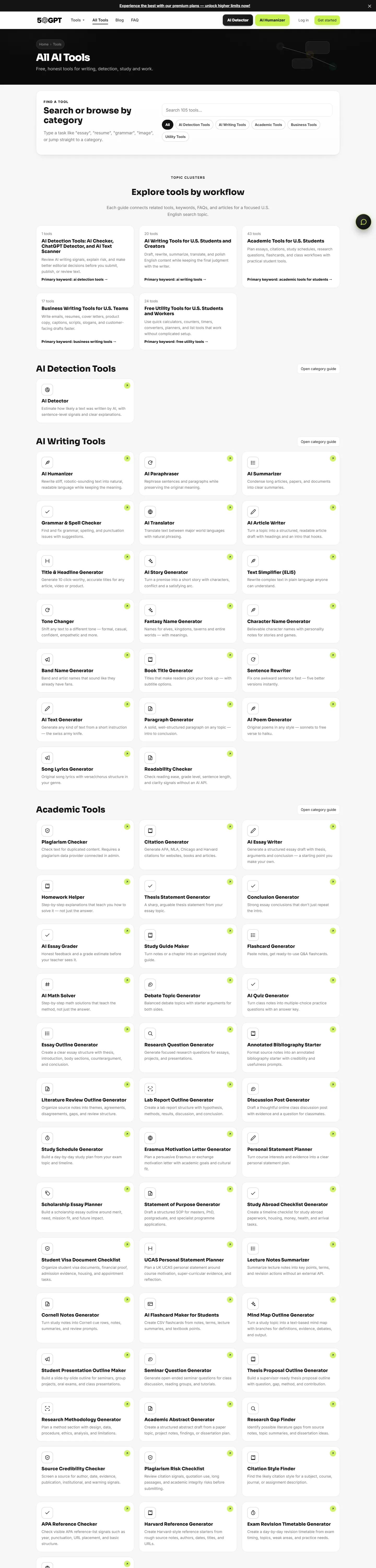
The directory page groups the catalogue into workflow sections with counts (for example 20 detection tools, 43 writing tools, 17 academic tools and 24 utilities at the time of review), offers a search that accepts words like essay, resume or grammar, and links related tools in clusters.
Task groups overlap; a summariser is both writing and academic. We chose a primary group per tool plus cross-links rather than a tag soup.
The whole catalogue is reachable in two clicks from the homepage; search-engine entry points exist per tool without duplicated pages.
Report machine-writing likelihood without inviting misuse.
False positives and false negatives are inherent to detection; short passages are especially unreliable. Presenting certainty would harm students and mislead reviewers.
Show sentence-level signals and a plain-language explanation, publish the limitations on the tool page, and frame the result as input to a human decision.
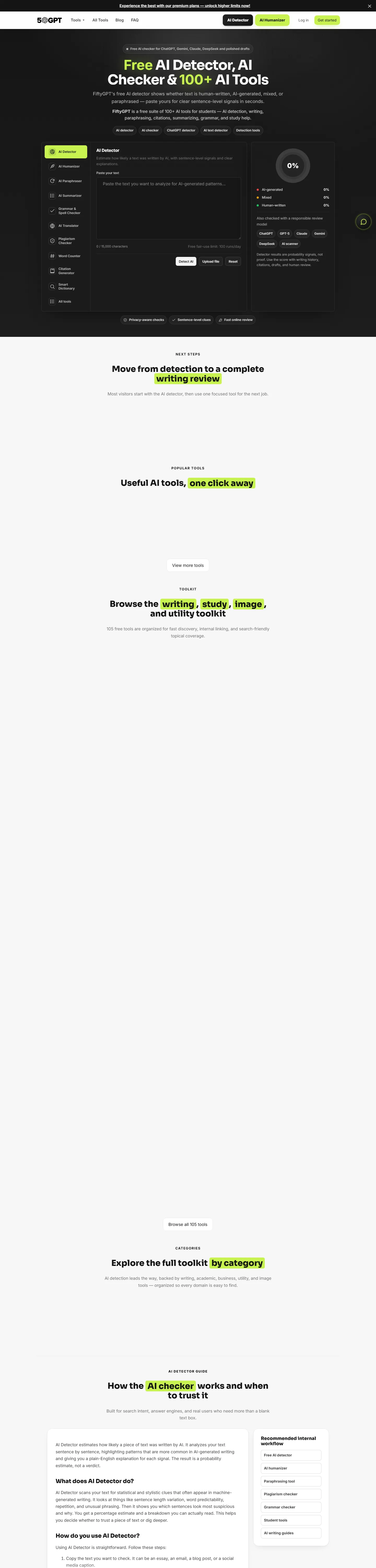
The detector accepts up to 15,000 characters, highlights sentence-level signals with explanations, offers a free fair-use limit of 100 runs per day without sign-up, and sits next to a limitations guide that discusses false positives and short-text risk.
Caveats reduce the drama of a single big number, which some competitors use as the hook. We accepted lower shock value for higher trust.
Live. Independent accuracy benchmarks have not been published and the page does not claim any.
Not every utility needs a language model, and the ones that do have very different cost and latency.
Running a word counter through a model API would be absurdly expensive; running a summariser without one would be useless. The architecture has to know which is which.
Classify tools by backend: pure text processing runs locally and instantly; model-backed tools go through a quota-aware service layer; tools that need an external dataset say so.
Counters, converters and planners execute without model calls. Writing and detection tools pass through a service that applies per-tool limits and plan entitlements. The plagiarism checker states that a search provider must be connected rather than claiming a complete index.
Three execution paths add complexity to the tool framework; the alternative of treating everything as a model call would have been simpler and financially unsustainable.
Free tools stay free because the expensive path is the exception, not the default.
Keep 105 pages consistent, useful and maintainable.
Inconsistent tool pages are slower to use, slower to build and look like thin content to search engines.
Define a single template (purpose, inputs, result, examples, limits, related tools) and generate each tool page from structured configuration.
Tool pages share one layout and one result component; copy and limits are configuration, so adding a tool is a configuration task rather than a front-end project.
A shared pattern constrains how different a specialised tool can look; genuinely different interactions (image tools, planners) get their own variants.
New tools ship in hours, and the catalogue reads as one product rather than a hundred experiments.
The platform has sign-in and premium plans, but the free experience must not feel like a paywall.
Visitors who are pushed to upgrade before they trust the output leave; the ones who trust it come back and convert on limits, not on pressure.
Explain limits and output reliability first; present premium plans as higher quotas rather than as the only way to get a result.
Free tools work without sign-up within fair-use quotas; the premium banner offers higher limits; the pricing page explains the plans.
Slower monetisation of first-time visitors in exchange for a product people recommend.
The free tier is genuinely usable; conversion figures are not published here.
Main features
All of these are live on fiftygpt.com as of the review date.
Technical architecture
FiftyGPT is a Laravel application. Tool definitions are configuration; tool pages are rendered from a shared Blade pattern; accounts, plans and quotas are enforced in a service layer that sits between the interface and the model providers.
The three execution paths, local text processing, model-backed calls and provider-dependent tools, are the architectural core. They decide what is free, what is metered and what must be labelled as unavailable until a provider is connected.
What we deliberately leave out: model providers, prompt design, API keys, rate-limit internals and hosting details are intentionally not described.
| Layer | What is in place |
|---|---|
| Backend | Laravel (PHP) with authentication, plan entitlements and per-tool quotas |
| Tool framework | Configuration-driven tool definitions rendered through one page pattern (purpose, inputs, result, examples, limits, related) |
| Execution paths | Local text processing · model-backed calls through a quota-aware service · provider-dependent tools (e.g. plagiarism) |
| Data | MySQL for accounts, plans, usage counters and tool configuration |
| Frontend | Server-rendered pages with responsive CSS; directory search and category navigation |
| Limits | Free fair-use quotas (100 detector runs/day at review) and premium entitlements enforced server-side |
| Content | Limitations guide for the detector; scope notes on provider-dependent tools |
User experience & responsive design
Genuine screenshots of the public site captured on 23 October 2026. Hover and click any image to open it in the viewer; click again for actual size.
The homepage is a working tool, not a brochure: paste, run, read. The directory and the rest of the catalogue are one click away.
Search accepts the words people use (essay, resume, grammar, image) and routes to the right group; nobody needs to know that a tool is called a humanizer.
Detection output is explained sentence by sentence with plain-language notes, so a non-technical reader can act on it without a glossary.
Large text areas, visible character limits and one primary action per screen keep the tools usable on a phone.
Fair-use limits are shown where they apply, so a visitor is never surprised by a wall.
Every tool uses the same structure, which makes the hundredth tool as easy to use as the first and keeps the accessibility behaviour (labels, focus order, headings) identical across the catalogue.
Technical challenges & resolutions
Each row records how it was verified and what remains open. Items marked as recommendations have not been implemented yet.
| Challenge | Root cause / constraint | Solution | Verification | Result or remaining limitation |
|---|---|---|---|---|
| Visitors could not find tools with similar names | A flat alphabetical list of a growing catalogue | Task-led groups, directory search on task words, related-tool clusters | Manual navigation checks per group; search terms tested against the catalogue | Every tool reachable in two clicks; usage analytics per path are not published |
| Detector scores were being read as proof | A single percentage with no context | Sentence-level signals, explanations and a published limitations guide | Copy and interface reviewed against known false-positive scenarios | Live; no accuracy benchmark is claimed |
| Free usage could run up unbounded model costs | Every tool initially treated as a model call | Three execution paths; server-side fair-use quotas and plan entitlements | Quota enforcement tested per tool and per plan | Costs bounded; load testing under realistic concurrency remains a recommendation |
| Catalogue pages drifted in structure and quality | Hand-built pages per tool | One configuration-driven page pattern | Template rendered across all 105 tools; spot checks of examples and limits | Consistent; tool-by-tool functional testing of every category is an open item |
| Plagiarism checking promised more than it could deliver | No connected search provider at the time | State the dependency on the tool page instead of simulating coverage | Copy review | Honest scope; provider connection is a roadmap item |
Estimated market development cost
What a platform of this scope would cost to commission from a competent agency in 2026: a configuration-driven tool framework, three execution paths, accounts and plans, and the content system behind 105 tool pages. Editorial estimates for comparable work, not quotes.
Comparable scope, 2026 market range
AED 65,000 – 205,000
Roughly 400–850 hours of design, engineering, QA, documentation and deployment at a blended agency rate; scope-dependent.
Model-provider usage fees, plagiarism-provider subscriptions and ongoing content for new tools are variable costs on top of the build.
Illustrative market development estimate for a comparable scope. This is not the actual project invoice, historical development cost or amount charged to a client.
| Comparable delivery component | Estimated range (AED) |
|---|---|
| Information architecture and interface design | 8,000 – 20,000 |
| Reusable tool catalogue and search | 12,000 – 40,000 |
| AI writing and tool workflows (service layer, quotas) | 20,000 – 75,000 |
| Accounts, limits and subscription journeys | 12,000 – 40,000 |
| Security, evaluation, QA and launch | 13,000 – 30,000 |
Component ranges are illustrative phase allocations, not measured hours or invoices. Third-party subscriptions, paid APIs, content production, hosting and marketing are excluded. Market context: Clutch web development pricing guide (Sept 2026), Dubai website cost comparison (Sept 2026) — editorial estimates by WebStackRank, not independently obtained quotes.
Results & outcomes
The outcomes are the ones a visitor can check on fiftygpt.com today. Traffic, conversion and model-accuracy figures are not published because they have not been independently verified.
Detection, writing, academic, business, utility and image tools organised by task with search and related clusters.
15,000-character input, sentence-level explanations, a 100-runs-a-day fair-use quota and a published limitations guide.
Sign-in, plan entitlements and a pricing page, with the free tier usable without an account.
Only model-backed tools consume metered calls; counters, converters and planners run without them.
A new tool is a configuration entry on a shared page pattern, not a new front-end build.
The plagiarism tool and the detector describe their limits on the page instead of implying coverage or certainty.
What this page does not claim: detector accuracy, subscription conversion, traffic and provider uptime. Those claims wait for independently collected evidence.
Lessons learned
Project status
Live · catalogue active
fiftygpt.com is live with a public directory of 105 tools, a free AI detector on the homepage with a daily fair-use quota, account sign-in and premium plans. A handful of catalogue entries are labelled coming soon on the site itself; everything described below as a feature is available today.
Status and figures reviewed on 23 October 2026 against the public site. FiftyGPT is an in-house product owned and operated by the WebStackRank founder.
Related projects


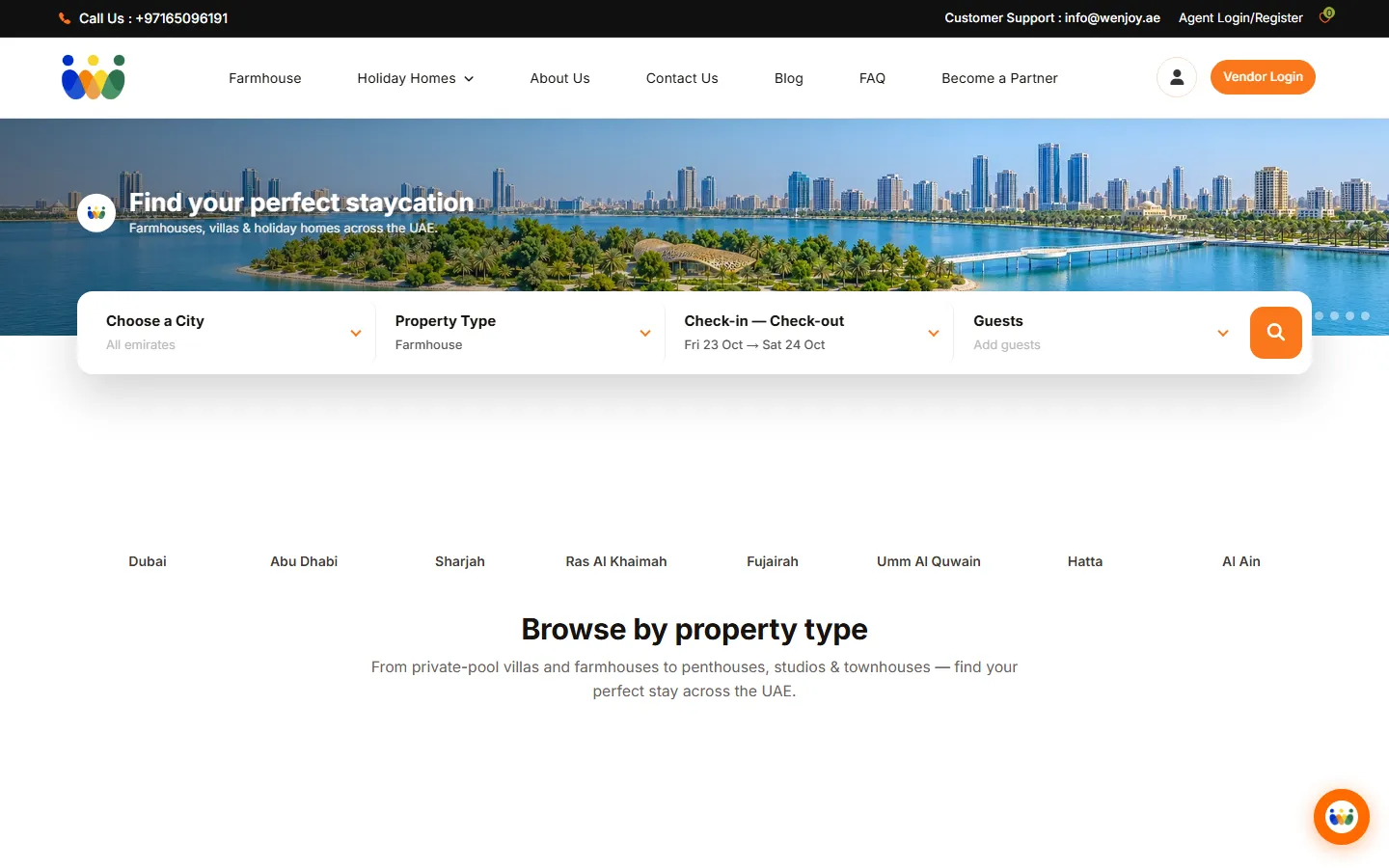
Whether you're planning a booking platform, SaaS product, business website or custom application, WebStackRank can help you turn the idea into a practical, maintainable digital product.
How would you like to reach us?
Thanks for chatting!
It was lovely to connect. Come back anytime — our starter packages and their 3 months free maintenance are on the pricing page whenever you're ready. See you again!
See the pricing page