Beyond Muscat, an Omani tourism website does not sell a room. It sells a place, in a season, at the end of a journey — and most sites fail because they are designed like a city hotel's: stock imagery, a room list, and an enquiry form where a visitor needed a reason, a season and a route. The method that works organises everything around those three facts: lead with the landscape guests travel for, design seasonal states for Khareef Dhofar and the winter desert, publish honest journey information from the Muscat gateway, and give each property type — hotel, camp, operator — the conversion path its reality allows.
The short answer: what an Oman tourism website must do that a city hotel site does not
| Design question | City hotel site | Oman tourism site beyond Muscat |
|---|---|---|
| What is the product? | A room in a known location | A place: wadi, dunes, mountain village, coast |
| When does it work? | All year, roughly the same | By season: Khareef green, winter desert, shoulder months |
| How do guests arrive? | A short transfer | A planned journey: gateway, route, driving time |
| What proves it? | Brand standards | Your photography, named hosts, stated access reality |
| What converts? | A booking engine alone | The right path per property: booking, availability request, structured enquiry |
| On what connection? | Fast city broadband | Rural and roaming connections: pages must stay light |
General hotel patterns still matter, and our guide to hotel, resort and travel website design covers them; this article covers what Oman adds. The Ministry of Heritage and Tourism's Experience Oman platform is now a national gateway where travellers can discover and book Omani providers, experiences and stays. Your website does not compete with it; it is where your place, seasons and terms get the depth no listing can carry.
Design for place: wadis, dunes, mountains and coast as the product
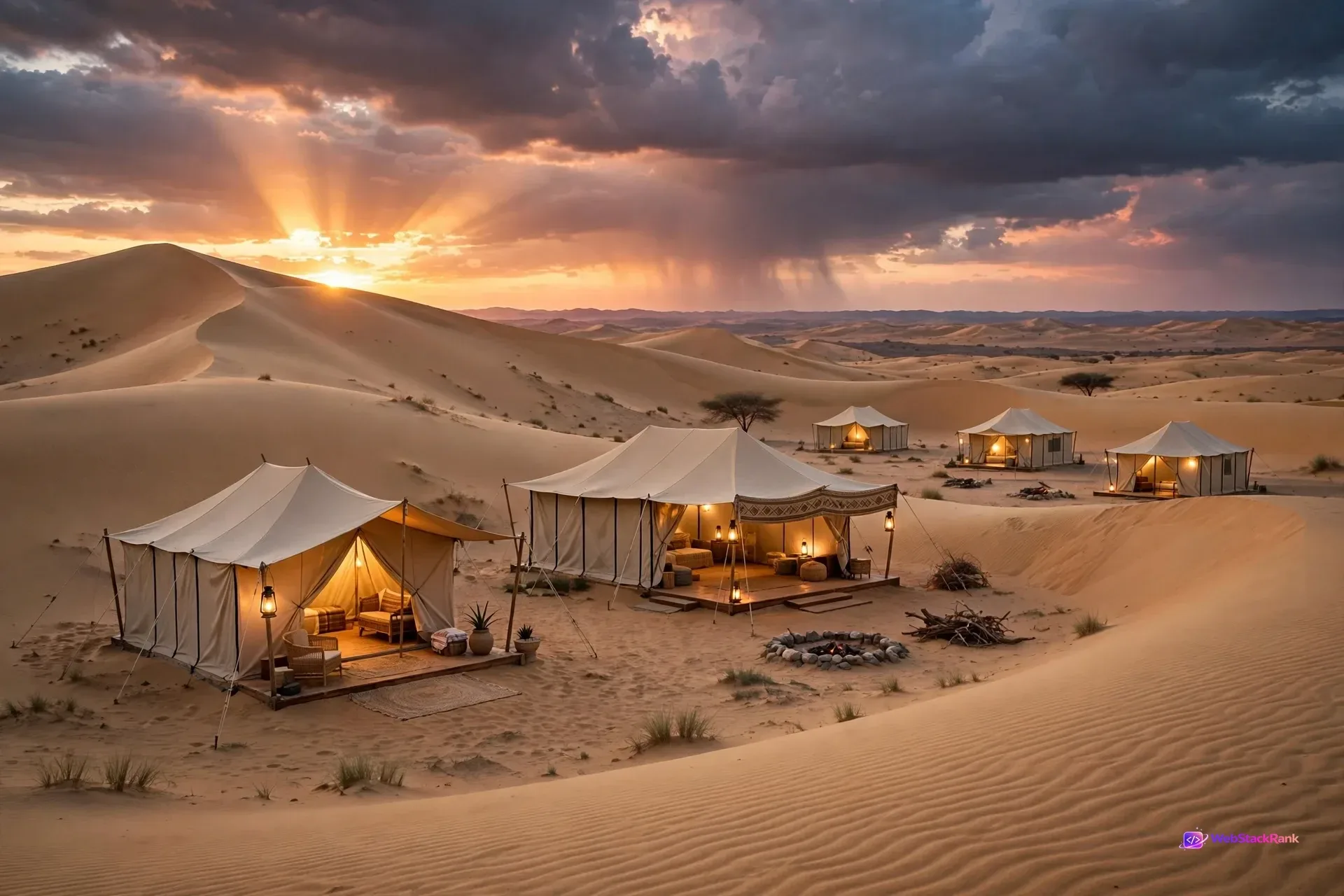
Start every property page with the landscape, not the lobby. A camp in the Sharqiyah sands, a guesthouse above a wadi, a hotel in Nizwa's old town and a coastal lodge near Sur are four different products even at the same room count, and a visitor should feel the difference within one screen: the hero image is your actual view, the first paragraph names your terrain, and rooms are the basecamp for that place.
Build a page per experience — the dawn dune drive, the wadi swim, the fort and souq morning, the turtle coast — each with photography, duration, difficulty and what to bring. Generic Muscat stock breaks this instantly: a visitor who suspects the photographs are not yours will suspect nothing else either.
Design for season: Khareef Dhofar, the winter desert and the shoulder months
Oman has at least two homepages. During Khareef, Dhofar turns green and misty and Salalah becomes the product; in winter the desert and interior are at their best and camps fill. A site showing one static face all year undersells both — and a camp promoting dates it does not operate misleads.
Use seasonal states, not redesigns. Build a Khareef state and a winter state for your homepage and key landing pages: imagery, lead experiences and prompts switch, while structure, URLs and booking paths stay stable. Publish your operating calendar plainly — one Wahiba Sands camp states its open season as October to April, other dates on request, beside its journey details.
Design for the journey: Muscat gateways, interior routes and honest distances
For most international guests your property is one stop on a route starting at Muscat's gateway, so design the journey as content. A good location page answers how a guest reaches you from Muscat, how long each leg honestly takes, what the last stretch is like, and what is worth stopping for. The Wahiba camp above publishes driving times from Muscat, Nizwa and Jabal Akhdar, names its nearest airport and gives coordinates.
Then design the route, not just the destination: itinerary pages chaining gateway, interior towns, desert and coast help a visitor commit to the trip, with your property inside it. If the final stretch needs a 4x4, a meeting point or a transfer you arrange, say so where the booking decision happens, not after the deposit.
Small hotels beyond Muscat: rooms, proof and trust without a brand flag
A chain hotel borrows trust from its flag. A small hotel in Nizwa, Sur or Salalah must manufacture its own, from specifics. Show the real rooms, photographed as they are, with sizes, occupancy and what the window looks onto. Name the people who run the place. Put practical facts beside the enquiry button: meals, parking, family arrangements, and check-in flexibility for late arrivals.
Display the credentials you hold, including your tourism authorisation details, where guests can find them without asking. Use only reviews you have. Everything on a small property's site can be true and checkable — design that makes verification easy converts better than design imitating a resort.
Desert camps: season windows, access reality and enquiry design
A desert camp page has four jobs a hotel page does not. First, the season window, stated as plainly as the October-to-April example above. Second, access reality: how far the camp sits from the road, whether guests self-drive to a meeting point, and how the transfer into the dunes works — one camp states it sits thirty minutes from the nearest road, reached only by 4x4, exactly the candour that prevents a bad arrival. Third, what the stay includes: meals, activities, guiding, and what the tents offer for power, water and connectivity. Fourth, an enquiry form designed for a camp: dates, party size, pickup point, dietary needs, and any mobility limits the desert makes relevant.
Answer those four and your enquiry arrives half-qualified.
Tour operators: itineraries a visitor can actually evaluate and book
An itinerary is evaluable when a visitor can price their commitment before enquiring: day by day, with driving distances, overnight places, inclusions and exclusions, group size, difficulty and pickup arrangements. Lay it out as a structured page per tour, not prose with a contact form under it.
The strongest operator sites in Oman sell personal expertise — individually designed tours, an on-site team, the right guide and vehicle matched to each party. That positioning converts when the site structures it: a bespoke-tour path beside the set itineraries, and a short enquiry capturing dates, party and interests. Expertise in prose reads as marketing; shown through one specified route, it reads as proof.
Photography and page speed on the connections your guests really have
Your guests research you on hotel Wi-Fi, roaming data and interior connections — and your team updates the site from the property. Design for the slowest, with disciplined photography rather than less of it: properly sized responsive images, compressed formats, lazy loading below the first screen, and no autoplaying hero video. Test throttled, on a mid-range phone, at every sign-off.
Shoot for the design: capture the images each page needs — the tent-door view, the morning wadi, the road in, the host — rather than filling templates with whatever exists. Our work across Oman follows the same rule: a tourism site's photography is its product photography.
Booking, enquiry and WhatsApp: choosing the conversion path per property
Match the path to the product's reality. A small hotel with stable inventory can take direct bookings or a clear availability request with a stated reply time. A camp whose stays depend on season, transfers and guiding should usually sell the structured enquiry above, with WhatsApp as the conversation channel after it, not the only door.
What matters is a designed, singular path honest about response times. This is a design article, not a booking-engine-economics one; our Qatar companion on direct booking engines for hotels works through that decision for its market.
Languages in the right order: international visitors first, Gulf visitors properly
For most properties beyond Muscat, English is the working language of the international visitors who book longest and earliest, so English comes first, written for travellers rather than translated from a brochure. Add languages by your enquiry evidence: German where your guest mix earns it, and Arabic done properly — full pages, not a mirrored homepage — for Gulf and domestic visitors, who travel in different seasons, including Khareef. Our multilingual website architecture guide covers the structure; our Arabic companion, the Oman tourism website for Gulf visitors, treats the Arabic-first version as its own design problem.
FAQ
Does a small desert camp need online booking, or is an enquiry enough?
An enquiry is enough when it is structured — dates, party size, pickup point and needs, with a stated reply time. Camps sell season-dependent stays with transfers and guiding, so a qualified enquiry often serves guests better than instant booking.
How do I show two different seasons on one website?
With seasonal states, not two websites. Build a Khareef state and a winter state for your homepage and main landing pages — imagery, lead experiences and prompts switch — while URLs, structure and booking paths stay the same. Publish your operating windows plainly in both states.
How fast does my site need to be for guests booking from abroad and in Oman?
Fast on a throttled, mid-range phone, not just on office broadband. Properly sized, compressed images, lazy loading and no autoplaying hero video are the core discipline.
Can I use stock photographs of Oman instead of my own?
No, not for your own property. Visitors forgive a modest room; they do not forgive discovering the dune, wadi or view in your hero image is not yours. Your product photography must be your place, honestly shot.
Which language should I add after English?
The one your enquiries support. For many Omani properties that is German for international guests, or Arabic — as complete pages — for Gulf and domestic visitors, including Khareef travellers to Dhofar. Add one language completely rather than several partially.
Get a tourism website designed around your place and season
If your website sells a room list while your business sells a landscape, we can redesign it around place, season and journey: seasonal states, honest route content, the right conversion path for your property type, and photography-led pages light enough for real connections. Start through our website development service — an itemised proposal within 24 business hours, full ownership of your site and content on final payment, and no retainer required. Tell us your property, seasons and guests.